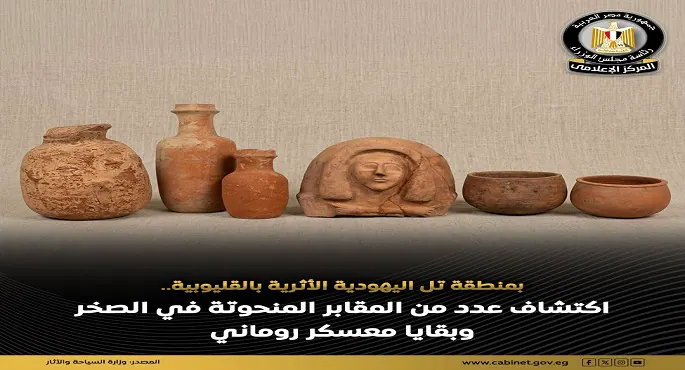
A recent archaeological discovery in Qalyubia Governorate has shed new light on the region's rich history. The Egyptian archaeological mission working at the Tel al-Yahudiya site has uncovered several rock-cut tombs, showcasing diverse architectural styles. This significant find provides valuable insights into the burial practices and architectural trends of the region throughout history. The tombs, carved into the rock, represent a rare find in the Delta region due to its characteristic clay soil.
The discovery is particularly noteworthy as it highlights the site's importance in understanding the evolution of burial practices in eastern Delta across various eras. The tombs, which date back to the late New Kingdom period, continued to be used until the Late Period. This prolonged use reflects the site's ongoing significance for funerary practices over successive historical periods. The archaeological evidence suggests that the site was utilized for an extended period, with the tombs serving as a testament to the region's complex history.
Excavations at the site have also led to the discovery of artifacts, which have helped determine the tombs' chronological framework. The findings indicate that the tombs were in use during the late New Kingdom period and continued to be utilized until the Late Period. This extended period of use underscores the site's importance for understanding the funerary practices and cultural developments of the region. The archaeological mission's work at Tel al-Yahudiya has significantly expanded our knowledge of the site's history and significance.
Further excavation has revealed the remains of a Roman camp in the surface layers above the rock-cut tombs. This additional discovery adds a new dimension to the site's history, highlighting its continued use during different historical periods. The presence of the Roman camp emphasizes the site's strategic importance and its enduring significance across the ages. The archaeological findings at Tel al-Yahudiya provide a unique window into the region's complex past.
The discovery of the rock-cut tombs and the Roman camp has significant implications for our understanding of the region's history. The site's importance extends beyond its archaeological significance, as it provides a unique insight into the cultural and historical developments of the region. The Egyptian archaeological mission's work at Tel al-Yahudiya has shed new light on the site's complex history, highlighting its importance as a major archaeological site in Egypt.
The Ministry of Tourism and Antiquities has announced the discovery, highlighting its significance for Egypt's rich cultural heritage. The discovery is a testament to the country's commitment to preserving its historical sites and promoting its cultural significance. The archaeological mission's work at Tel al-Yahudiya is a significant addition to our understanding of Egypt's history and cultural heritage.
The discovery of the rock-cut tombs in Qalyubia Governorate is a significant archaeological find that sheds new light on the region's history. The site's importance extends beyond its archaeological significance, as it provides a unique insight into the cultural and historical developments of the region. The Egyptian archaeological mission's work at Tel al-Yahudiya has significantly expanded our knowledge of the site's history and significance.
Key points
- The discovery of several rock-cut tombs in the Tel al-Yahudiya archaeological site in Qalyubia Governorate, dating back to various periods.
- The tombs, carved into the rock, represent a rare find in the Delta region due to its characteristic clay soil.
- The site's importance extends beyond its archaeological significance, as it provides a unique insight into the cultural and historical developments of the region.