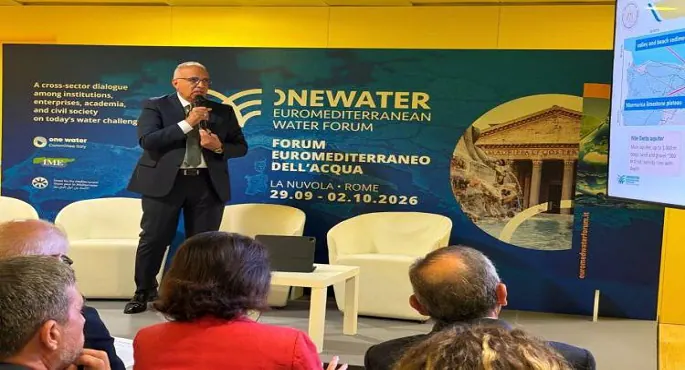
Egyptian Minister of Water Resources and Irrigation, Hani Suwelim, participated in a session titled "Protecting Coastal Aquifers and Associated Ecosystems to Achieve Water Security in the Mediterranean Region through Science and Integrated Management." The session was part of the Euro-Mediterranean Water Forum held in Rome, Italy. Suwelim emphasized that coastal aquifers are crucial for water security but face increasing pressure due to climate change, rising sea levels, and urban expansion.
Suwelim highlighted the need for an integrated approach combining scientific management of water resources, coastal planning, and climate change adaptation. He stressed that dealing with coastal areas should not only focus on visible impacts of sea-level rise but also consider hidden effects, such as rising groundwater levels and increased salinity. The minister underscored the importance of monitoring, scientific modeling, and early preparedness to effectively address these challenges.
Egypt has prepared a comprehensive plan to manage coastal areas until 2100, based on the latest climate scenarios and risk maps. The plan includes studying the impacts of sea-level rise, seawater intrusion into groundwater, changes in groundwater levels, and erosion and sedimentation risks. This provides a scientific basis for planning and future decision-making. The plan aims to provide a framework for sustainable development and investment in coastal areas.
The results of scientific studies and models will guide development plans and future investments, while also developing standards and codes for implementing infrastructure projects in coastal areas. This will enhance their ability to adapt to expected climate impacts and increase their resilience in the long term. Egypt has gained significant experience in protecting coastlines and integrated coastal zone management in collaboration with international partners.
Suwelim emphasized the need to transition from experimental studies and projects to scalable and applicable solutions, linking scientific knowledge to planning, investment, and actual implementation on the ground. He noted that the challenges posed by sea-level rise and seawater intrusion affect not only Egypt but also many Mediterranean countries, making regional cooperation and exchange of experiences essential.
The minister highlighted the importance of enhancing cooperation between Mediterranean countries, international institutions, research centers, and financing agencies. This cooperation will help convert scientific research and climate models into executable programs, investments, and adaptation measures, ultimately protecting water resources, coastal areas, and ecosystems. This will contribute to achieving greater water security and climate resilience in the region.
The comprehensive plan to manage coastal areas against climate risks until 2100 reflects Egypt's commitment to addressing the challenges posed by climate change. By adopting a proactive and integrated approach, Egypt aims to ensure the long-term sustainability of its coastal areas and protect the livelihoods of communities dependent on these regions.
Key points
- Egypt's Minister of Water Resources and Irrigation, Hani Suwelim, announces a comprehensive plan to manage coastal areas against climate risks until 2100.
- The plan includes studying the impacts of sea-level rise, seawater intrusion into groundwater, changes in groundwater levels, and erosion and sedimentation risks.
- Egypt seeks to enhance cooperation with Mediterranean countries, international institutions, and research centers to address climate change challenges.