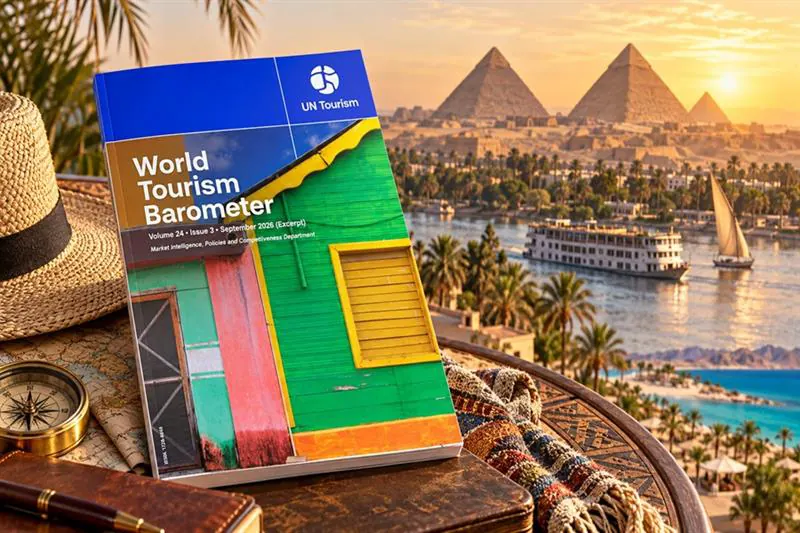
Egypt received 3% more international tourists in the first half of 2026 than in the same period of 2025, according to UN Tourism's September World Tourism Barometer. This increase contrasts with a 22% decline across the Middle East, where conflict disrupted flights and weakened traveller confidence. The first-half increase for Egypt marked a slowdown from a 16% rise in the first quarter.
Worldwide, an estimated 690 million tourists travelled internationally between January and June, about three million more than a year earlier, representing an increase of 0.4%. Global arrivals rose 2% in the first quarter before falling 1% in the second quarter. Arrivals fell 3% in April due to the Easter holiday period beginning in March and the Middle East conflict.
The UN Tourism report also highlighted that air traffic disruptions caused by the conflict gradually eased in May and early June after a ceasefire, allowing some routes to reopen. However, the improvement in consumer sentiment was uneven. Egypt's second-quarter decline followed a stronger start to the year, with government figures showing arrivals reached 6.1 million in the first four months, up 7% from 5.7 million a year earlier.
More recent cabinet figures put January–August arrivals at 12.7 million, up about 4.1%, while tourism revenues rose 1.7% to $12 billion over those eight months. Tourism and Antiquities Minister Sherif Fathy said Egypt expects around 20 million tourists by the end of 2026, compared with approximately 19 million in 2025. Visitors from France increased 17% in the first half, according to ministry figures.
Across other regions, Africa recorded the strongest first-half growth at 4%, followed by Europe at 3% and the Americas at 2%. North Africa grew 3%, including a 6% rise in Morocco. Europe received almost 350 million international tourists during the period, while arrivals in Asia and the Pacific rose 1% but remained 11% below their 2019 level.
The report also showed the impact on aviation, with international passenger traffic rising 0.4% globally in the first half, according to figures cited from the International Air Transport Association. However, international air capacity declined 0.6% worldwide, including a 20% contraction in the Middle East. UN Tourism now expects international arrivals to grow by 1–2% for the full year, cutting its January forecast of 3–4%.
For Egypt, the longer-term question is how much visitor capacity can keep pace with demand. A separate hotel-development survey counted 45,984 rooms in the pipeline across 185 Egyptian projects in 2026. However, those figures include signed projects at different stages and do not represent rooms already available to tourists. Experts ranked economic pressures and high transport and accommodation costs as the leading challenges for tourism in 2026.
Key points
- Egypt's tourist arrivals increased by 3% in the first half of 2026.
- The Middle East saw a 22% decline in tourist arrivals during the same period.
- UN Tourism expects international arrivals to grow by 1–2% for the full year.