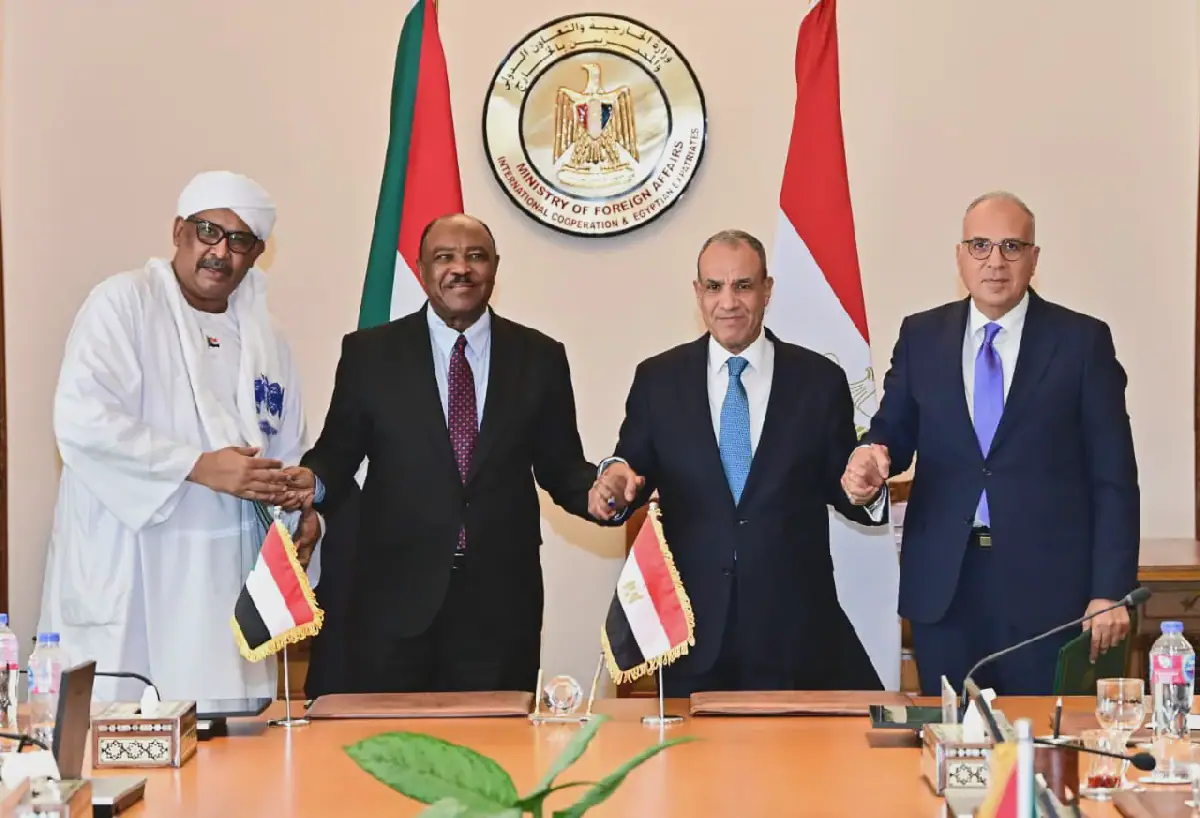
Egypt and Sudan have reiterated their rejection of unilateral actions in the Eastern Nile Basin, warning that Ethiopia's management of its dam on the Blue Nile without a binding legal framework poses a continuing threat to the water security of the two downstream countries. This stance was outlined in a joint statement following the third round of the "2+2" consultation mechanism between the foreign and irrigation ministers of Egypt and Sudan, held in Cairo. The meeting was led by Egyptian Foreign Minister Badr Abdelatty and Minister of Water Resources and Irrigation Hani Sewilam, and Sudanese Foreign Minister Mohi El-Din Salem and Minister of Agriculture and Irrigation Ismat Qurashi.
The two countries described their water security as "indivisible" and reaffirmed their full water rights and existing uses under the 1959 Nile Waters Agreement. They called on Ethiopia to abandon unilateral policies and resume cooperation in accordance with international law, including the principles of avoiding significant harm, prior notification, consultation, and consensus. Egypt and Sudan stressed that the Ethiopian dam dispute concerns the three Eastern Nile Basin countries — Egypt, Sudan, and Ethiopia — rejecting attempts to involve other Nile Basin countries in the dispute.
Egypt and Sudan reaffirmed the role of their Permanent Joint Technical Commission for Nile Waters in developing common positions and agreed to provide it with the necessary technical and logistical support. They also expressed support for development projects in the southern Nile Basin, provided they meet the required technical standards and are subject to prior notification, consultation, and agreement in accordance with international law.
The two countries also called for preserving the Nile Basin Initiative as an inclusive platform for cooperation and supported continued consultations on the Cooperative Framework Agreement, with the aim of restoring the participation of all basin countries and addressing their concerns. This move is seen as an effort to maintain a collaborative approach to managing the Nile's resources.
On Sudan, Egypt reiterated its rejection of the establishment or recognition of parallel governing entities, reaffirming its support for the country's unity, territorial integrity, and state institutions. Egypt remained prepared to take measures permitted under international law and the two countries' joint defence agreement to support Sudan and protect Sudanese sovereignty and state institutions.
The two sides also condemned attacks by "rebel militias" on electricity and water infrastructure in Sudan using drones launched from a neighbouring country. They discussed Sudan's recovery and reconstruction efforts, with Khartoum seeking to establish a broader partnership with Egypt. Egyptian technical work to assess damage and carry out maintenance at the Jebel Aulia Dam was also highlighted.
On the Red Sea, Egypt and Sudan stressed that its governance should remain the exclusive responsibility of littoral states, rejecting maritime access for non-littoral countries if it comes at the expense of the sovereignty or territorial integrity of coastal states. They also opposed attempts to militarise the Red Sea and agreed to intensify political, economic, and water cooperation, including support for Sudan's reconstruction and training programmes for Sudanese irrigation officials.
Key points
- Egypt and Sudan reaffirm their 1959 Nile water rights and reject Ethiopia's unilateral dam management.
- The two countries stress the importance of cooperation and prior notification in managing the Nile's resources.
- Egypt and Sudan also discuss Sudan's unity, Red Sea governance, and cooperation on development projects.