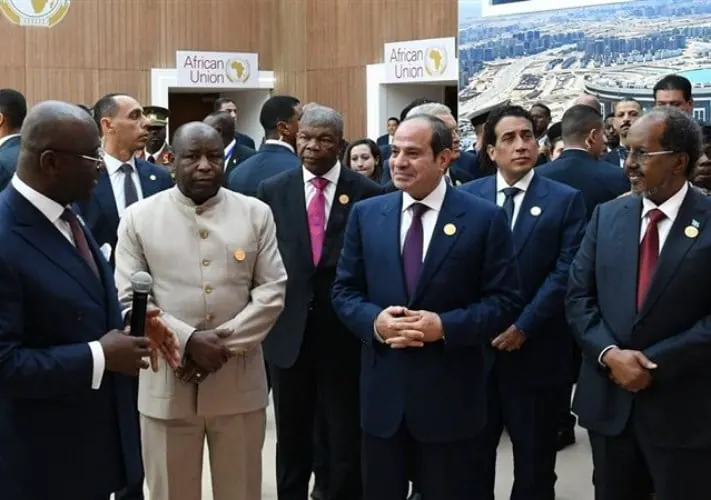
Egyptian President Abdel Fattah el-Sisi hosted a quadrilateral summit in the city of El Alamein, bringing together Eritrean President Isaias Afwerki, Somali President Hassan Sheikh Mohamud, and Sudanese Sovereign Council head Abdel Fattah al-Burhan. The summit resulted in the "El Alamein Joint Declaration," emphasizing the importance of respecting national sovereignty, independence, and territorial unity. The leaders reaffirmed their commitment to promoting regional stability and development through cooperation and dialogue.
The El Alamein Joint Declaration highlights the need for enhanced political, commercial, and economic cooperation among the four nations. The leaders agreed to intensify consultations and coordination on regional and international issues, supporting shared interests and fostering economic integration and sustainable development. This cooperation aims to strengthen the nations' capabilities to address common challenges and promote peace and stability in the region.
During the summit, the leaders engaged in in-depth discussions on pressing regional and international issues, exploring ways to enhance cooperation and support stability and development. They emphasized the importance of adhering to international law principles, including respect for national sovereignty, independence, and territorial unity. The leaders also reaffirmed their commitment to promoting peaceful and political solutions to conflicts, supporting national institutions, and rejecting external interference.
Regarding Sudan, the leaders expressed their support for the country's unity, sovereignty, and territorial integrity, as well as its national institutions. They rejected the establishment of parallel entities and emphasized the need for a Sudanese-led and owned political process. The leaders also stressed their opposition to any support for mercenaries and their commitment to promoting a peaceful and stable Sudan.
The summit also addressed the situation in Somalia, with the leaders reaffirming their support for the country's unity, sovereignty, and territorial integrity. They rejected any external interference or actions that could undermine Somalia's national sovereignty and unity. The leaders also expressed their support for Somalia's efforts to combat terrorism and enhance state institutions, calling on international partners to provide predictable and sustainable funding for the African Union Support and Stability Mission in Somalia.
The El Alamein Joint Declaration also emphasizes the importance of freedom of navigation in the Red Sea, with the leaders stressing that the governance of the Red Sea is the exclusive responsibility of the coastal states. Furthermore, they highlighted the need to respect international law, particularly regarding transboundary rivers such as the Nile River, and rejected any unilateral actions that could harm the existing water uses of Nile River basin countries.
The leaders agreed to establish a follow-up mechanism to monitor the implementation of the summit's outcomes, with the summit to be held periodically as needed. They also expressed their commitment to continuing consultations and coordination among the four nations and with other African countries. The summit concluded with expressions of gratitude from the participating leaders for Egypt's hosting of the event.
Key points
- The four nations reaffirmed their commitment to promoting regional stability and development through cooperation and dialogue.
- The leaders rejected any unilateral actions that could harm the existing water uses of Nile River basin countries.
- The summit resulted in the "El Alamein Joint Declaration," emphasizing the importance of respecting national sovereignty, independence, and territorial unity.