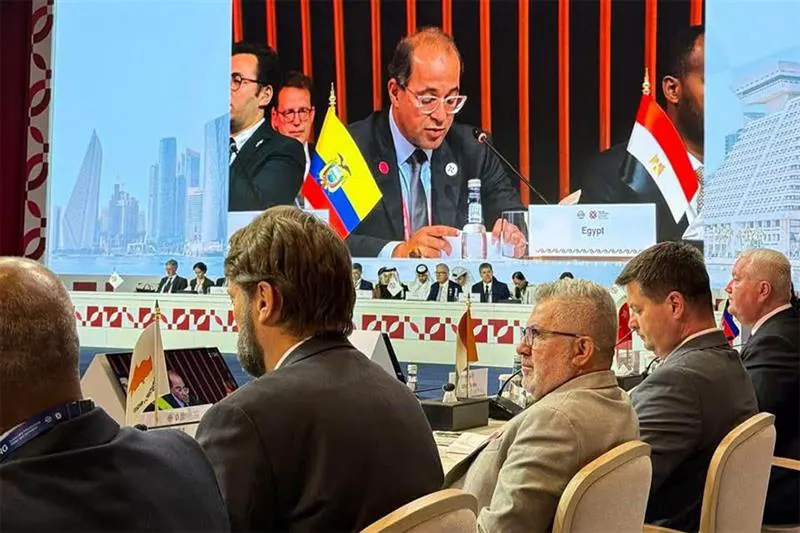
Egyptian Finance Minister Ahmed Kouchouk met with Qatari Finance Minister Ali bin Ahmed Al-Kuwari in Doha to discuss expanding Egyptian-Qatari investment and trade cooperation. The meeting took place on the sidelines of the Asian Infrastructure Investment Bank (AIIB) meetings. Kouchouk stated that Egypt is looking to increase Qatari investments in the Egyptian market to support economic growth, create jobs, and expand investment between the two countries.
During his meeting with Al-Kuwari, Kouchouk emphasized the importance of broader Egyptian-Qatari partnerships in strengthening the private sector's role in economic activity. He identified energy and tourism as priority areas for greater investment and trade cooperation. The two finance ministries also discussed strengthening cooperation in financial and tax policy, including the exchange of expertise and capacity building.
Kouchouk participated in an AIIB session on financing for development, highlighting the need to convert economic reforms into actual investments for sustainable growth. He noted that public-private partnership projects represent a natural transition for investment in infrastructure, with a focus on sustainable and renewable energy. Egypt aims to encourage investment in new and renewable energy to improve the competitiveness of its exports.
The Egyptian Finance Minister also called for more diversified financing instruments and guarantees to encourage private investment in development projects. He cited Egypt's issuance of panda bonds as an example of innovative financing and said guarantees provided by development banks could help attract additional investors. Kouchouk emphasized the need for a greater role for multilateral development banks in turning economic reforms and development projects into investments.
During the AIIB meetings, Kouchouk called for a greater role for the bank in providing development financing that responds to member states' needs for more advanced and climate-resilient infrastructure. He also requested that the bank's financing policies take into account the economic conditions and development priorities of individual countries. Egypt has implemented infrastructure projects covering transport, electricity, water, sanitation, and the transition towards renewable energy.
Kouchouk also met with Tanzanian Finance Minister Khamis Mussa Omar to discuss expanding economic and financial cooperation between Egypt and Tanzania. He expressed Egypt's desire to build on existing partnerships and expand cooperation opportunities, particularly for Egyptian private-sector companies seeking to enter the Tanzanian market. The two ministers discussed cooperation between their finance ministries at regional and international forums and the exchange of expertise on financial and economic issues.
The meetings in Doha reflect Egypt's broader effort to diversify sources of investment and development finance while giving a larger role to private capital in infrastructure and productive sectors. Egypt is seeking to translate its economic reform program into tangible investments and strengthen the role of private capital in infrastructure and other productive sectors. The country aims to attract more diversified, long-term financing for development projects, particularly in energy, renewable energy, and infrastructure.
Key points
- Egypt seeks to increase Qatari investments and expand private-sector partnerships to support economic growth and development projects.
- The country aims to attract more diversified, long-term financing for development projects, particularly in energy, renewable energy, and infrastructure.
- Egypt is looking to strengthen cooperation with multilateral development banks to turn economic reforms and development projects into investments that can be implemented.