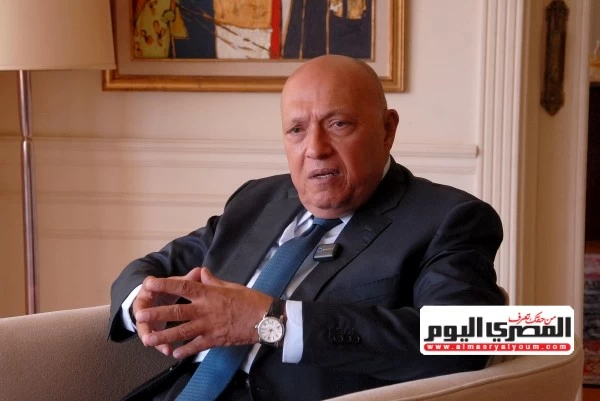
Egypt's former Foreign Minister Samih Shukri has stated that the Iranian-American war has not yet reached its final stage, with tensions between the two nations still ongoing. Shukri noted that both sides are using their strengths to try to gain concessions from the other. He made these comments during an interview with journalist Sharif Amer on the "Hatha Fi Masr" program on MBC Egypt.
Shukri discussed the indirect consultations that took place at the United Nations, which were described as positive but did not lead to a conclusive outcome. He emphasized that the continued conflict between Iran and the US affects not only the two nations but also the Gulf states, the global economy, and freedom of navigation. Shukri stressed that these developments have an impact on Egypt, particularly in terms of labor movement and economic remittances.
Regarding Egypt's relationship with the US, Shukri stated that Egyptian-American relations have remained stable, despite differences in approach under US President Donald Trump. Shukri described Trump's style as characterized by fluctuating positions. He highlighted that the two nations have a mutual understanding of the importance of their relationship.
Shukri emphasized that the Palestinian issue remains a central concern for the Arab world, warning that its resolution could lead to new waves of instability. He expressed concern that ignoring the Palestinian issue and the lack of progress in achieving Palestinian aspirations could lead to the exploration of alternative means. Shukri believes that addressing the Palestinian issue is essential to achieving regional stability.
Shukri called for greater Arab coordination, stressing that Arab national security should be a priority. He proposed the formation of a small Arab committee, comprising Egypt, Saudi Arabia, and Jordan, to address regional challenges, including the Palestinian issue and the perceived Iranian threat to Gulf states. Shukri argued that increased Arab coordination would enhance the ability of Arab nations to manage concurrent crises.
Regarding Arab cooperation, Shukri noted that the Arab charter is already in place, and the primary responsibility lies in implementing its commitments. He cautioned that revising the charter could be contentious and might exacerbate divisions. Shukri linked current regional developments to the need for strengthened Arab coordination mechanisms.
Shukri concluded that while Iran's resilience may appear to be a victory, the situation is not yet conclusive. He emphasized the importance of addressing regional challenges through a unified Arab stance.
Key points
- Samih Shukri proposes a small Arab committee to address regional threats
- The Palestinian issue remains a central concern for the Arab world
- Increased Arab coordination is necessary to manage concurrent crises