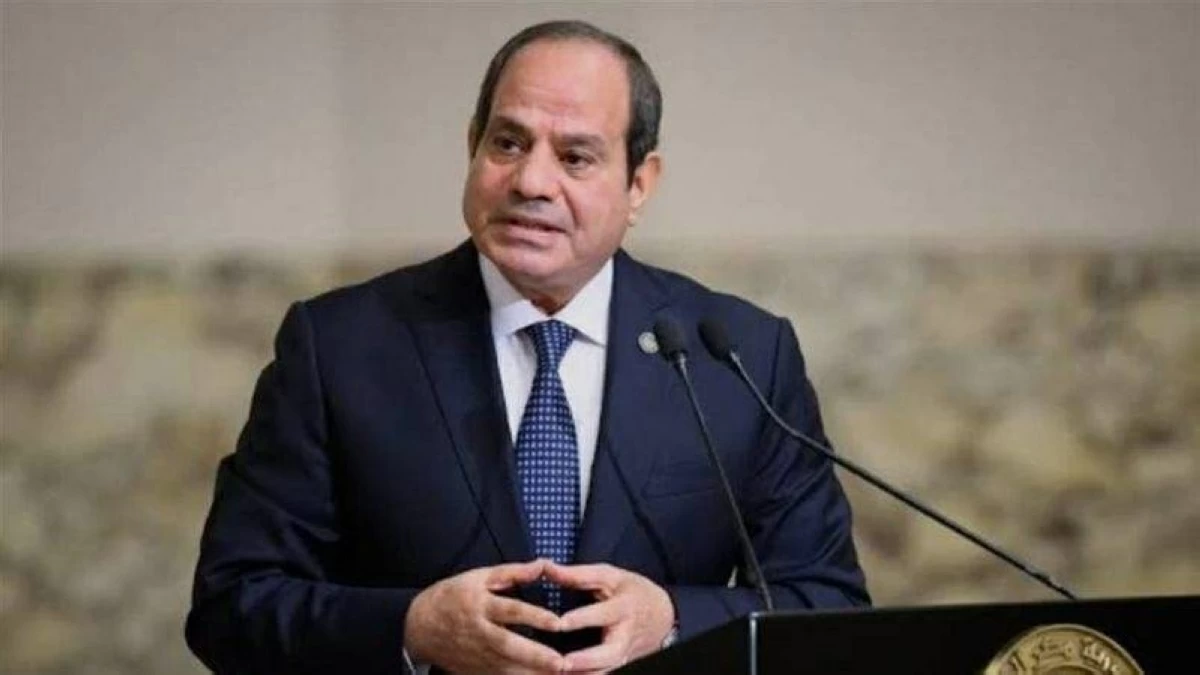
On September 22, President Abdel Fattah al-Sisi issued a presidential decree delegating the Minister of Defense and Military Production to exercise specific powers stipulated in Articles 9, 12, and 24 of Law #87 of 1960. The decision, published in the Official Gazette, is set to take effect in November and will be in place for a period of one year. This move has sparked interest and raised questions among citizens, with some speculating about its implications.
According to Mohamed al-Ghabbary, the former Director of the National Defense College, the decision is a routine legal and administrative measure that recurs whenever a new Minister of Defense assumes office. He explained that the President, as head of the National Defense Council, delegates specific powers to the Minister of Defense in accordance with legal provisions. This process allows the Minister to undertake tasks alongside his primary duties.
The delegation of powers is linked to the General Mobilization Law, which relies on both active-duty and reserve forces to bring the armed forces up to the required strength. Al-Ghabbary noted that an army's peacetime force typically ranges between 50-70 percent, and mobilization serves to bring that force up to the required level. This process is applicable to both peacetime and wartime scenarios, and is not a new decision linked to an emergency situation.
Al-Ghabbary emphasized that the decision does not signal a change in the state of general mobilization, as a mobilization plan is already in place. The call-up of reservists or reinforcement of units is linked to training exercises and operations conducted by the armed forces. He stressed that the current decision constitutes neither a declaration of war nor a declaration of a state of emergency, but rather a routine legal procedure.
Abu Bakr al-Gendy, the former head of the Central Agency for Public Mobilization and Statistics (CAPMAS), explained that the general mobilization system encompasses an inventory of the state's civilian resources. This allows them to be utilized in accordance with specific needs and governing regulations. He cited the events of 2011 as an example of the practical importance of this system, where the state was able to leverage available resources to respond rapidly to disruptions.
During the 2011 events, the armed forces intervened using their own transport assets to move and distribute wheat supplies within a short timeframe. A decision was issued to deploy transport vehicles to move quantities of wheat from areas such as Alexandria and Suez to other governorates, facilitating the delivery of supplies to citizens. This successful handling of circumstances was linked to the existence of a database and prior inventory of civilian capabilities.
The delegation of powers to the Minister of Defense has raised questions among citizens, with some inquiring about its implications. Al-Ghabbary affirmed that citizens have the right to ask such questions, and that it is the role of specialists to clarify the nature and rationale of the decision. He emphasized that the decision is a routine procedure that repeats with the change of the Minister of Defense.
Key points
- The decision to delegate powers to the Minister of Defense is a routine legal and administrative measure.
- The General Mobilization Law relies on both active-duty and reserve forces to bring the armed forces up to the required strength.
- The delegation of powers does not signal a change in the state of general mobilization or a declaration of war.