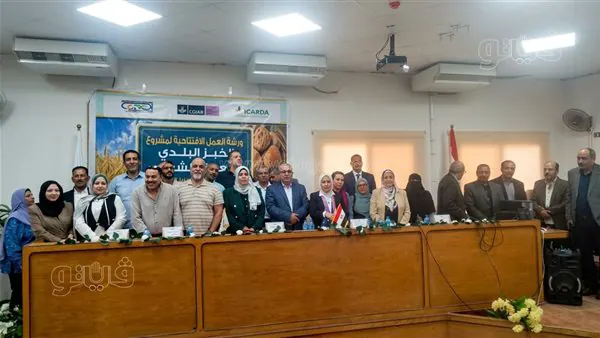
The New Valley province in Egypt has initiated a project to integrate barley into the production of local bread. This project is a collaboration between the Center for Development of the North and Central Plateau Region in the New Valley Governorate, the Egyptian Academy of Scientific Research and Technology, the Agricultural Research Center, and the International Center for Agricultural Research in the Dry Areas (ICARDA). The project aims to enhance food security and nutrition in Egypt by utilizing locally produced barley.
The project was launched with a workshop that included introductory sessions on the project's objectives, outcomes, and implementation plan. The workshop also featured technical lectures on the nutritional value of barley, its use in bread production, and the mechanisms of grinding barley for use in existing mills. The project targets the New Valley Governorate, which is one of the governorates with the highest production of barley in Egypt.
The project aims to apply a comprehensive model for integrating barley into the production of local bread, enhancing the resilience of Egypt's food system and promoting the use of local crops that can withstand harsh climatic conditions and limited water resources. Barley is known for its high tolerance to drought and salinity, and its low water requirements compared to wheat. It also has high nutritional value, containing fibers and beta-glucan, which can help regulate blood sugar levels and lower cholesterol.
The project involves applying the production of barley-enriched bread in two bakeries in the New Valley Governorate, specifically in the Al-Kharga and Al-Dakhla centers. This will allow for the evaluation of production stages and the assessment of consumer acceptance of the new product. The project also aims to study the technical, economic, and operational aspects related to grinding, mixing, baking, and supply, with the goal of developing a scalable model.
According to the Agricultural Department in the New Valley Governorate, approximately 24,000 feddans of barley were planted in the current season, with an expected production of around 42,000 tons. The governorate has the potential to expand barley cultivation, especially in newly distributed lands for small farmers and large investors. Barley cultivation offers several advantages, including its resistance to drought, salinity, and cold temperatures, making it a suitable crop for the region.
The project also aims to provide a comprehensive approach to developing wheat and barley bread, from the field to the bread loaf. This includes adopting specifications for wheat-barley bread, securing local supplies of seeds and production, evaluating the compatibility of supply chains, and building a financial and economic feasibility study. The project seeks to develop a standard for wheat-barley bread, a national seed system for naked barley, and a local production system for barley with guaranteed contracting and supply mechanisms.
The project's outcomes are expected to contribute to reducing Egypt's import bill, saving foreign currency, and enhancing the nutritional value of bread. The integration of barley into bread production is also expected to promote consumer acceptance and trust in the product. The project's findings and recommendations will inform policy decisions and guide the expansion of barley cultivation and bread production in Egypt.
Key points
- The New Valley province in Egypt has launched a project to integrate barley into bread production, aiming to enhance food security and nutrition.
- The project involves applying the production of barley-enriched bread in two bakeries in the New Valley Governorate.
- The project aims to develop a comprehensive model for integrating barley into bread production, from the field to the bread loaf.