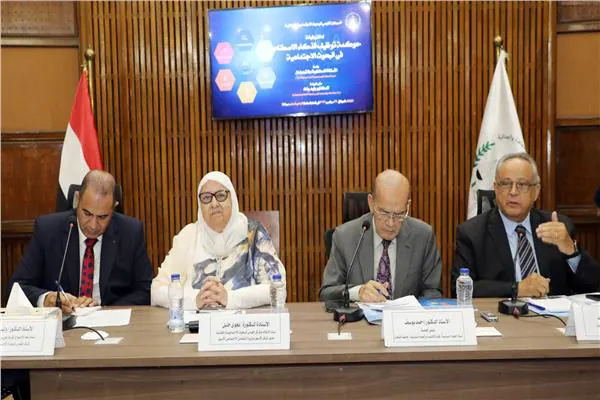
The National Center for Social and Criminal Research in Egypt announced a new document on September 29, 2026, titled "Governance of Employing Artificial Intelligence in Social Sciences." This initiative aims to keep pace with rapid technological advancements and promote responsible and ethical use of AI applications in scientific research. The document was unveiled during a session held at the Ibn Khaldun hall in the center's headquarters.
The event, attended by experts, academics, and executives from various Egyptian universities and institutions, was held under the auspices of Dr. Hala Ramadan, director of the center. In her opening speech, Dr. Ramadan emphasized the center's commitment to scientific and ethical responsibility, ensuring that AI applications adhere to the rules and ethics of research. She highlighted the importance of addressing social risks associated with technological advancements.
The document, prepared under Dr. Ramadan's supervision and edited by Dr. Walid Rashad, a professor of sociology at the center, aims to provide a national roadmap for researchers in Egypt and the Arab world. It focuses on utilizing AI applications to analyze complex social and criminal phenomena while maintaining the integrity of scientific research and protecting societal privacy. The document outlines controls to ensure responsible AI use, aligning with international ethical standards.
Dr. Ahmed Youssef, a professor of political science at Cairo University, chaired the session and stressed the significance of the center's initiative in establishing guidelines for AI use in scientific research. The document seeks to support commitment to research ethics and regulations amid the increasing use of AI technologies. Dr. Walid Rashad presented an overview of the document's key features and contents.
The event also included a presentation by Dr. Hind Nabil, a media instructor and member of the executive supervision body of the center's media observatory. She discussed the center's work mechanisms and the potential for employing AI applications in media content analysis. Dr. Nabil highlighted the observatory's reliance on scientific foundations and methodologies to analyze media content and extract quantitative indicators.
The session witnessed several discussions and interventions from experts and academics regarding the document's provisions, principles, and articles. Participants included Dr. Najwa Khalil, a professor of media and former Minister of Social Solidarity, and Dr. Ahmed Zaid, a professor of sociology at Cairo University. The discussions aimed to convert the document into practical procedures for implementing AI governance in research.
The document's launch marks a significant step towards integrating AI applications in social sciences research in Egypt, ensuring that these technologies are used responsibly and ethically. Key stakeholders, including Dr. Hala Ramadan and Dr. Walid Rashad, emphasized the importance of this initiative in promoting a culture of responsible AI use in the research community. The center's efforts aim to foster a collaborative environment for researchers and policymakers to address the challenges and opportunities presented by AI.
Key points
- The National Center for Social and Criminal Research in Egypt has launched a document to govern the use of artificial intelligence in social sciences research.
- The document aims to promote responsible and ethical use of AI applications in scientific research.
- The initiative seeks to provide a national roadmap for researchers in Egypt and the Arab world to utilize AI applications in analyzing complex social and criminal phenomena.