A delegation from Egypt's Ministry of Social Solidarity recently visited Brazil to review the country's experience in social protection and economic empowerment. The visit was part of efforts to enhance international cooperation and exchange expertise in social protection. The Egyptian delegation, led by Raft Shafik, Assistant Minister of Social Solidarity for Social Protection and Human Development, included representatives from the Ministry of Labor and the National Social Insurance Authority.
The visit was organized by the United Nations Economic and Social Commission for Western Asia (ESCWA) and the German Development Cooperation Agency. It brought together delegations from four countries: Egypt, Jordan, Morocco, and Tunisia. The main objective was to review Egypt's experience in implementing social protection programs, particularly the 'Takaful and Karama' program, and to learn from Brazil's experience in social protection.
During the visit, the Egyptian delegation met with representatives from Brazil's Ministries of Social Security, Development, and Social Assistance, and Labor. They learned about Brazil's digital platforms for social protection services, mechanisms for exiting cash support, and ways to expand social insurance coverage to informal workers. The delegation also learned about Brazil's Unified Social Registry (Cadastro Único), which integrates data and verifies it through links with various national databases.
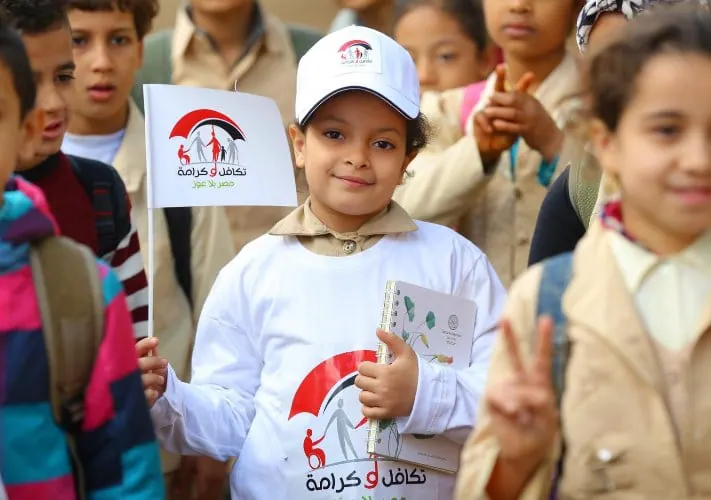
Raft Shafik presented the 'Takaful and Karama' program, which relies on social registry databases identified by national ID numbers and linked to partner government and national databases. The program has expanded significantly since its launch, with the number of beneficiary families increasing from 1.7 million in 2014 to 4.7 million currently. The program's budget has also increased from 6.8 billion Egyptian pounds to 54 billion pounds in the 2025-2026 fiscal year.
The 'Takaful and Karama' program has contributed to a 2.3% reduction in the national poverty rate, while the poverty rate among beneficiaries decreased by 9.6%. The program combines two types of support: conditional cash support for families with children and unconditional cash support for the elderly, people with disabilities, and orphans. In contrast, Brazil's 'Bolsa Familia' program focuses mainly on low-income families, while support for the elderly and people with disabilities is provided through a separate program.
The Egyptian delegation learned about Brazil's advanced experience in mechanizing social protection services and expanding their availability to beneficiaries. They also learned about the Unified Social Registry (Cadastro Único), which is a national database of low-income families used to identify beneficiaries of social programs, including 'Bolsa Familia' and the Continuous Cash Benefit (BPC) program.
The Ministry of Social Solidarity aims to study the experiences and practices learned during the visit to enhance the efficiency of Egypt's social protection system and achieve the highest possible benefits for families and individuals in need. The ministry is committed to strengthening cooperation with international partners to improve social protection services and promote economic empowerment for those who need it most.
Key points
- Egypt's 'Takaful and Karama' program has expanded significantly since its launch, with 4.7 million beneficiary families currently.
- The program has contributed to a 2.3% reduction in the national poverty rate.
- The Egyptian delegation learned about Brazil's advanced experience in mechanizing social protection services.