The world celebrates the International Day of Peace on September 21st every year, an occasion marked by the United Nations to promote peace values, reject violence, and foster a culture of dialogue and tolerance among nations. Egypt, in particular, has a long and pivotal history in supporting peace and stabilizing the region and the world. According to Youssef Ahmed Al-Sharkawy, former Assistant Minister of Foreign Affairs and member of the Egyptian Council for Foreign Affairs, Egypt's role in promoting peace dates back to around 7,000 years ago.
Al-Sharkawy noted that the first peace treaty in history was the Treaty of Kadesh in 1258 BC, signed between Pharaoh Ramses II and the Hittites. This treaty established the foundations of international law and peaceful conflict resolution, emphasizing the principles of not seizing others' lands by force, not attacking others, and respecting borders and sovereignty. These principles remain fundamental to the current UN Charter and international law.
Egypt's role in supporting global peace and stability has continued through various periods, with the country defending the Arab region and the Islamic world. As one of the founding members of the United Nations in 1945, Egypt participated in drafting the UN Charter and has continuously worked to achieve global peace. Al-Sharkawy stressed that peace does not mean surrender, but rather having peaceful means to resolve conflicts, citing the Egyptian-Israeli peace process as an example.
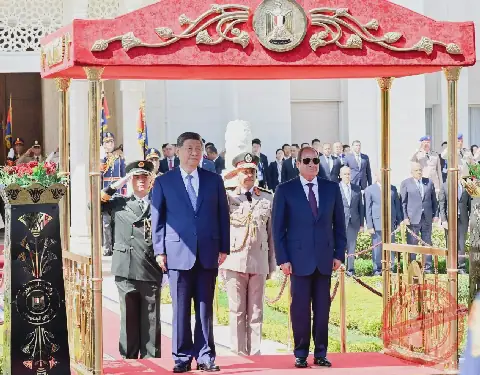
The Egyptian-Israeli peace process, which began after Egypt's victory in the 1973 October War, was built on the principles of strength, justice, and international law. President Abdel Fattah El-Sisi has consistently emphasized the importance of respecting state sovereignty and territorial integrity, as well as non-interference in other countries' affairs, which are fundamental principles of international law and the global peace agenda.
The International Day of Peace has become a pressing necessity to unify international efforts in addressing challenges, escalating conflicts, and expanding wars. Egypt's President El-Sisi has called for achieving a two-state solution and stopping Israeli aggression against the Palestinian, Syrian, and Lebanese peoples. Al-Sharkawy highlighted the importance of having genuine political will to resolve conflicts peacefully.
Al-Sharkawy also emphasized the need for cooperation between countries and peoples to achieve peace, which can be achieved not only at the official level but also at the non-official level. He cited the participation of 193 countries in high-level UN meetings, as well as the involvement of non-governmental organizations, which can obtain consultative status in the Economic and Social Council.
In conclusion, Egypt's history of supporting peace and stability in the region and globally is a testament to the country's commitment to promoting peace values and rejecting violence. As the world celebrates the International Day of Peace, Egypt's role in fostering a culture of dialogue and tolerance serves as a model for other nations to follow.
Key points
- Egypt has a long history of supporting peace and stability in the region and globally.
- The International Day of Peace is celebrated on September 21st every year to promote peace values and reject violence.
- Egypt's role in promoting peace is built on the principles of strength, justice, and international law.