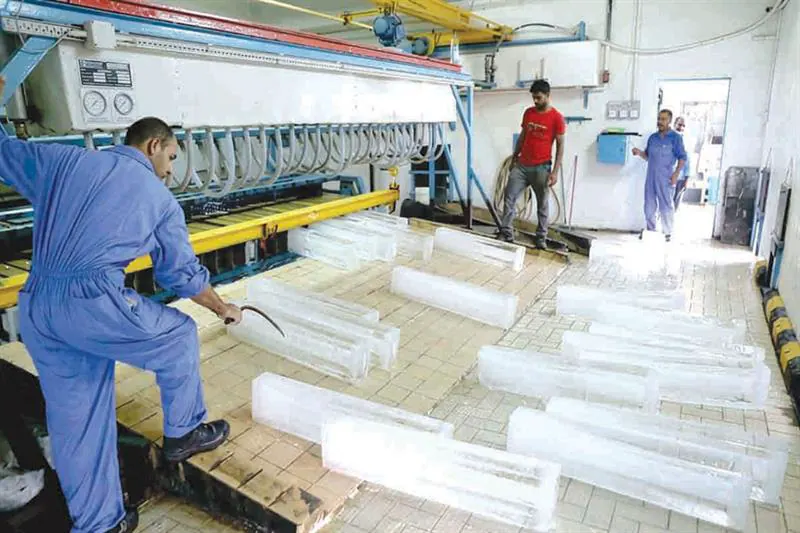
In the heart of Egypt's scorching summer, ice factories are operating at full capacity to meet the increasing demand for their product. The country's capital, Cairo, is experiencing extremely high temperatures, often reaching above 40°C. Despite the harsh conditions, workers at these factories are putting in extra hours to produce ice blocks that are essential for preserving food, particularly in the country's bustling markets. The ice factories are a crucial part of Egypt's commercial infrastructure, providing a vital service to businesses and households alike.
One such factory is located in the popular neighborhood of Rod Al-Farag in Choubra, Cairo. Behind a gray façade, the factory is a hive of activity, with workers laboring tirelessly to produce ice blocks. The interior of the factory is a stark contrast to the scorching heat outside, with a humid atmosphere and a constant hum of machinery. Workers are tasked with producing tons of ice blocks per day, which are then transported to markets and businesses across the city. The factory's workers are skilled at handling the physical demands of their job, but they still face numerous challenges, including the risk of injury and illness.
Mahmoud Mostafa, an exhausted worker at the factory, explained that the summer months are the busiest time for ice production. "When it's very hot, we feel the difference immediately in the rhythm of work," he said. "The trucks arrive more often, the blocks pile up, and we have to prepare everything at a frantic pace." The workers' shifts are long and grueling, with some employees working for hours without a break. Despite the challenges, the workers take pride in their role in providing a essential service to the community.
The importance of ice in Egypt's commercial sector cannot be overstated. In the country's fish markets, ice is used to preserve the freshness of the catch, while in other markets, it is used to keep drinks and other perishable items cool. The demand for ice is highest during the summer months, when the temperature can be extremely high. To meet this demand, ice factories like the one in Rod Al-Farag operate around the clock, producing thousands of tons of ice blocks per day.
According to Ihab Al-Cherbiny, a historian and researcher, the use of ice in Egypt dates back several centuries. "The conservation of food by cold means existed even under the Mamluks," he explained. "It was a luxury reserved for kings, princes, and the upper classes." Over time, the production of ice became more widespread, with the establishment of the first ice factories in Egypt over a century ago. Today, these factories continue to play a vital role in the country's commercial sector.
The process of making ice blocks is complex and involves several stages. First, water is introduced into metal molds, which are then placed in large refrigeration units. The water is frozen into ice blocks over a period of several hours, after which they are removed from the molds and transported to customers. The entire process requires careful planning and execution to ensure that the ice blocks are produced efficiently and safely.
As the summer months continue to bring extreme heat to Egypt, the country's ice factories will remain a crucial part of the commercial infrastructure. The workers at these factories will continue to labor tirelessly to produce the ice blocks that are essential for preserving food and keeping businesses running smoothly. Despite the challenges they face, these workers play a vital role in supporting Egypt's economy and ensuring that the country's citizens have access to the goods and services they need.
Key points
- Egypt's ice factories produce thousands of tons of ice blocks per day to meet the soaring demand during the country's sweltering summer months.