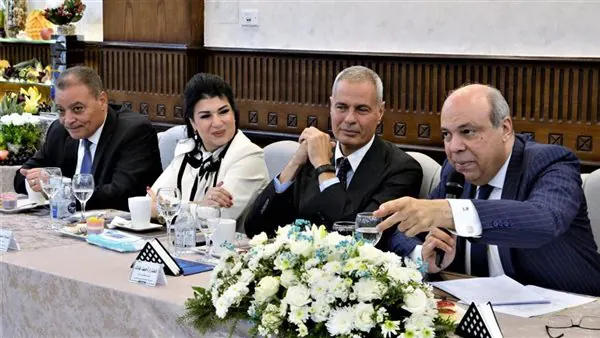
Dr. Samah El-Hafnawy, Egypt's Minister of Civil Aviation, recently met with aviation journalists to discuss the latest developments in the sector. The meeting, attended by several high-ranking officials, focused on the outcomes of Egypt's participation in the second edition of the El Alamein International Aviation and Space Exhibition (EIAS 2026). The minister expressed his pride in the achievements of the national carrier, EgyptAir, which was recognized as the most improved airline globally by Skytrax.
During the meeting, Dr. El-Hafnawy reviewed the results of Egypt's participation in EIAS 2026, which saw significant international participation. He praised the success of the exhibition, which showcased Egypt's capabilities in the aviation and space sectors. The minister also thanked the Ministry of Defense and other relevant authorities for their effective coordination and organization of the event. Egypt's participation in the exhibition resulted in effective partnerships, agreements, and strategic projects with major international and regional companies.
The meeting also touched on the state's efforts to enhance partnerships with the private sector in managing, operating, and developing Egyptian airports. This move is in line with the cooperation with the International Finance Corporation (IFC), the private sector development arm of the World Bank Group. The goal is to leverage specialized technical and administrative expertise to improve operational efficiency, enhance service levels, and increase the competitiveness of Egyptian airports.
Regarding the project to manage, operate, and develop Hurghada International Airport, Dr. El-Hafnawy revealed that 10 alliances had expressed interest in participating in the pre-qualification stage. After evaluating the qualification requests and submitted documents, seven alliances were shortlisted to proceed to the next stage of the bidding process. The minister emphasized that the involvement of the private sector in airport management does not imply the disposal of Egyptian airports or relinquishing state ownership.
The minister highlighted that the duration of the concession for managing and operating airports is expected to be around 30 years, subject to the necessary approvals, including parliamentary consent. This timeframe will enable the winning alliance to implement its development plans and achieve the expected returns, considering the nature of each project and the required investments. The minister anticipated that the winning bidder would be announced within six to eight months after the request for proposals (RFP) is issued.
Dr. El-Hafnawy stressed that the involvement of the private sector in airport management does not mean that current employees will be laid off. Instead, the goal is to preserve and develop the workforce through retraining, qualification, and efficiency enhancement, in line with modern operational requirements. The minister emphasized that employees are a crucial element and a safety valve for the civil aviation sector.
The meeting also covered plans to develop Egyptian airports and increase their capacity, including the expansion of Cairo International Airport and the development of new airports, such as those in Sphinx, El Alamein, and the New Administrative Capital. The minister highlighted the importance of integrating airport development projects with other transportation networks, including rapid transportation systems and electric trains, to enhance connectivity and provide a seamless travel experience.
Key points
- The Egyptian government is seeking partnerships with the private sector to manage, operate, and develop its airports.
- Seven alliances have been shortlisted to bid on the management and operation of Hurghada International Airport.
- The development of Egyptian airports aims to increase their capacity to nearly 100 million passengers annually.