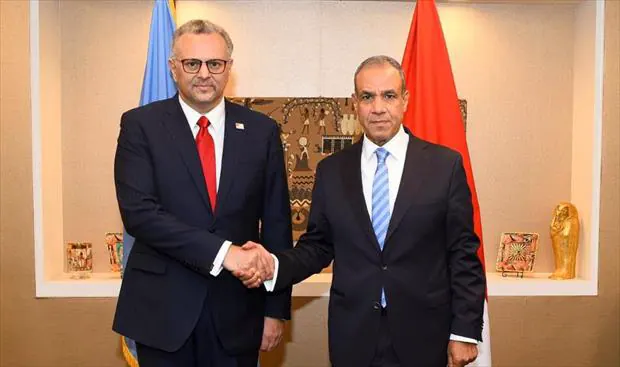
Egyptian Foreign Minister Badr Abdelkhalek emphasized the importance of integrating regional and international efforts to support Libya's political path. This would help Libyan parties reach a sustainable solution that reflects their will and preserves the country's unity and institutions. Abdelkhalek made these remarks during a meeting with Mesad Boles, the US President's senior adviser for Arab and African affairs.
The meeting between Abdelkhalek and Boles focused on Libya's situation and ways to advance the political process. They also discussed means to end the division in the country. According to a statement by the Egyptian Ministry of Foreign Affairs, both officials stressed the need for a unified effort to support Libya's stability. The meeting comes as Libya continues to face significant challenges in its transition to a stable and democratic government.
Abdelkhalek and Boles had a phone conversation on Saturday, discussing Libya's situation and potential ways to move forward with the political process. The Egyptian Foreign Minister reiterated his country's commitment to supporting Libya's unity and stability. He emphasized that Egypt's actions regarding Libya are guided by the principles of preserving the country's unity, sovereignty, and territorial integrity.
Boles recently launched an initiative aimed at breaking the current political deadlock in Libya. However, the initiative has faced criticism for focusing on achieving understanding among Libya's elites and dominant forces. Critics argue that this approach may lead to the entrenchment of power-sharing arrangements at the expense of progress toward elections and the end of the transitional phase.
In response to criticism, Boles stated that the US approach focuses on unifying institutions and executive authority, alongside security and economic arrangements. The goal is to make progress in resolving the political impasse in Libya. The initiative reportedly includes a formula for power-sharing, with Abdul Hamid Dbeiba continuing as head of the government and Sadam Hifter, deputy commander of the Libyan National Army, taking over as head of the Presidential Council.
The Egyptian Foreign Minister and Boles also discussed the importance of supporting Libya's national institutions and preserving the country's sovereignty. Abdelkhalek stressed that Egypt's efforts to address the Libyan crisis are driven by a commitment to the country's stability and unity. The two officials agreed on the need for a coordinated international effort to support Libya's transition to a stable and democratic government.
The situation in Libya remains complex, with various factions and interest groups vying for influence. The international community continues to play a significant role in efforts to stabilize the country and support its transition to democracy. Egypt and the US are working together, along with other international partners, to find a solution that supports Libya's sovereignty and stability.
Key points
- Egypt and the US are working together to support Libya's political process and stability.
- The Egyptian Foreign Minister and US President's adviser discussed ways to advance Libya's political process.
- Libya's situation remains complex, with various factions and interest groups vying for influence.