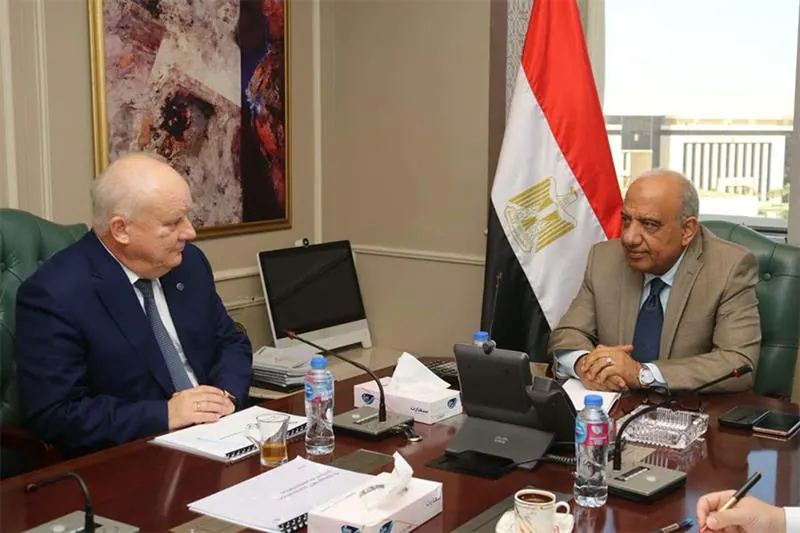
Egyptian Electricity and Renewable Energy Minister Mahmoud Esmat met with Andrey Petrov, first deputy director general of Russia's state nuclear corporation Rosatom, to discuss the El-Dabaa Nuclear Power Plant project. The meeting, held at the ministry's headquarters in the New Capital, was also attended by Sherif Helmy, chairman of Egypt's Nuclear Power Plants Authority (NPPA). They reviewed progress on the project's components and preparations to receive nuclear fuel next year.
The two sides discussed coordination between the Egyptian and Russian teams working on the plant, including preparations to receive the nuclear fuel and progress towards connecting electricity generated by the plant to Egypt's national grid. Esmat and Petrov also reviewed the manufacture of equipment for the plant, including turbines that will generate electricity from the reactors.
The meeting covered expanding training programs for personnel who will operate the plant, including increasing opportunities for training both in Egypt and abroad. This is part of Egypt's national energy strategy, which aims to increase the use of renewable and clean energy, reduce reliance on fossil fuels, meet rising electricity demand, and strengthen energy security.
The El-Dabaa Nuclear Power Plant, Egypt's first nuclear power plant, is being built on the Mediterranean coast in Matrouh with Russian assistance. The plant will consist of four Generation III+ VVER-1200 reactors, each with a capacity of about 1,200 megawatts, giving it a total capacity of 4,800 megawatts. Atomstroyexport, a subsidiary of Rosatom, is building the four reactors.
Construction began on the units between 2022 and 2024, with work now focused on installing major reactor and turbine equipment. Unit 3 recently reached a major construction milestone with the installation of the lower plate of its reactor pit. This follows the installation of its dry shielding on 28 August, as part of preparations to install the unit's 320-tonne reactor pressure vessel.
Egyptian and Russian officials emphasized the importance of continued coordination to complete the El-Dabaa project, describing it as a key part of Egypt's peaceful nuclear energy program and a reflection of the strategic partnership between the two countries. The project aims to support Egypt's energy needs and contribute to the country's economic development.
The El-Dabaa project is a significant component of Egypt's energy strategy, which seeks to diversify the country's energy mix and reduce its reliance on fossil fuels. The plant is expected to play a crucial role in meeting Egypt's growing electricity demand and promoting sustainable energy development in the region.
Key points
- Egypt and Russia are working together to complete the El-Dabaa Nuclear Power Plant project, with nuclear fuel delivery expected next year.
- The project aims to support Egypt's energy needs and contribute to the country's economic development.
- The El-Dabaa plant will consist of four reactors with a total capacity of 4,800 megawatts, making it Egypt's first nuclear power plant.