Egyptian water officials have dismissed viral social media reports alleging the total failure of flood protection dams in Nuweiba. The Ministry of Water Resources and Irrigation assured the public that the infrastructure successfully contained massive rainwater surges following recent torrential storms across South Sinai. The ministry rebuffed claims of three-meter-high floodwaters breaking through defenses, clarifying that all primary dams in the region remain fully intact and performed precisely as engineered.
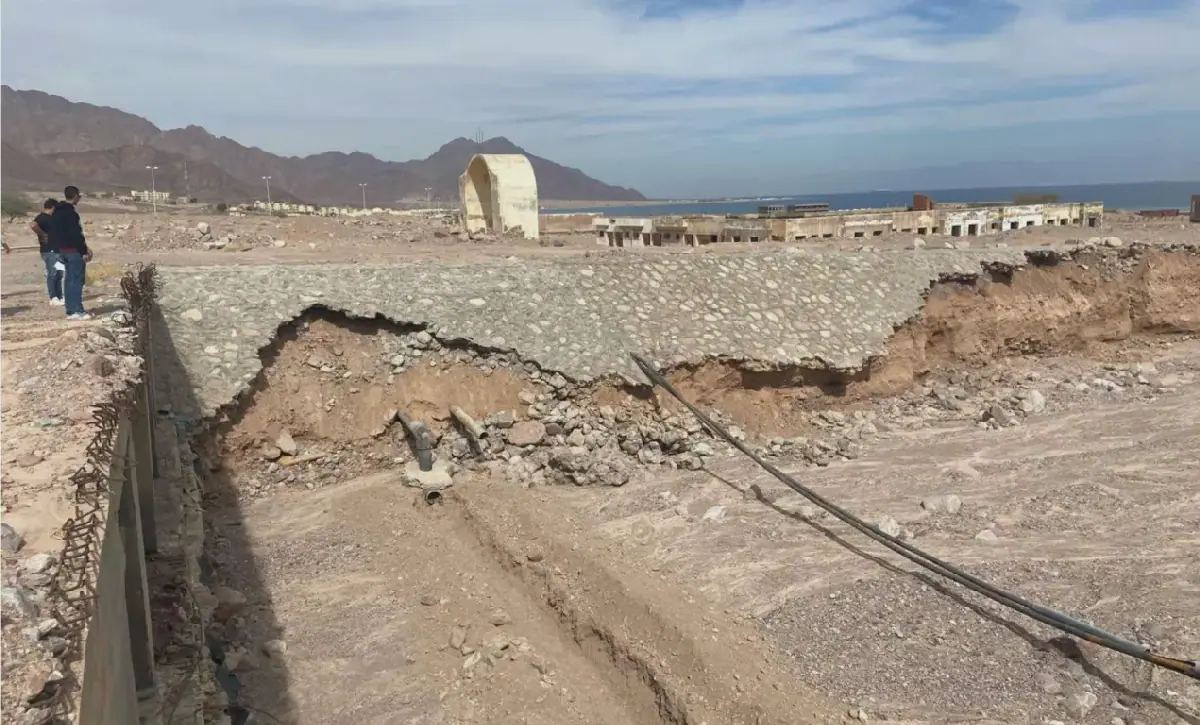
The Ministry of Water Resources and Irrigation attributed the viral imagery of eroded ground and damaged infrastructure to a coastal bridge support on the Sharm El-Sheikh–Taba highway, which is outside the ministry's jurisdiction. However, the ministry acknowledged that localized secondary barriers did sustain damage. A concrete barrier located 300 meters from the asphalt and a primary gabion barrier 600 meters out bore the brunt of the runoff and will require substantial maintenance.
A third barrier situated 1,600 meters out, intersecting with the circular embankment shielding the Arab Hamdan area, is currently undergoing technical evaluations to determine necessary repairs. The flood defense system across the strategic Wadi Watir basin proved vital during the severe downpour on October 27, capturing approximately 13 million cubic meters of rainwater. This recent investment is part of the ministry's ongoing efforts to enhance the region's flood protection infrastructure.
To date, the ministry has invested LE 660 million into the basin's infrastructure, establishing a network of 14 dams, 6 lakes, 20 barriers, and 3 Irish crossings with a total storage capacity of 32.9 million cubic meters. The infrastructure has been designed to mitigate the impact of torrential storms and protect local communities. The ministry's efforts aim to ensure the region's flood protection system can handle extreme weather events.
Following the storm, specialized joint committees comprising ministry engineers, the National Water Research Center, and experts from Cairo and Ain Shams universities were dispatched to audit all regional water structures. The audit aims to assess the current state of the infrastructure and identify areas for improvement. This proactive approach will help the ministry to refine its flood protection strategies and prevent similar incidents in the future.
Looking ahead, Egypt plans to execute an ambitious LE 10 billion phased expansion designed to capture up to 76.37 million cubic meters of the area's estimated 87 million cubic meters total flood runoff capacity. The initiative will introduce 9 new dams, 15 lakes, 14 barriers, and 20 stilling basins alongside extensive road protection measures. This upgrade plan is expected to significantly enhance the region's flood protection capabilities.
The ministry concluded its statement by urging media outlets and the public to verify information through official channels and refrain from spreading unverified rumors. The ministry's swift response and clarification have helped to alleviate concerns and provide a more accurate understanding of the situation. By investing in its flood protection infrastructure, Egypt aims to protect its communities and mitigate the impact of extreme weather events.
Key points
- Egypt's Ministry of Water Resources and Irrigation has invested LE 660 million in the Wadi Watir basin's infrastructure, which includes 14 dams and 6 lakes with a total storage capacity of 32.9 million cubic meters.
Reporting sources
- Egypt responds to reports of dam collapse in Sinai · Egypt Independent