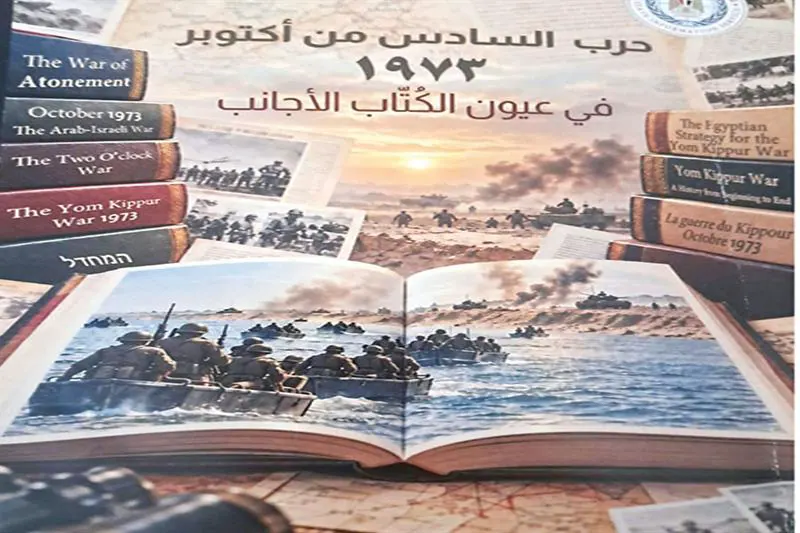
On the 53rd anniversary of the 1973 October War, Egypt's General Organization for Information, led by Ambassador Alaa Youssef, has published a book that examines the war through military documents, analysis, and foreign authors' perspectives. The book, titled "The 1973 October War Through the Eyes of Foreign Authors," offers a comprehensive look at the conflict, combining Egyptian and foreign accounts. This publication aims to provide a deeper understanding of the war and its implications.
The book is divided into two main sections. The first part, "The October 1973 War: From Military Challenge to Peace," covers the years leading up to the war, including Egypt's military reconstruction, the war of attrition, and the strategic decisions that allowed Egypt to break free from the status quo imposed after the 1967 defeat. This section draws on declassified military documents and memoirs of key figures involved in the war. It highlights the main stages of Egypt's preparation, including the deployment of missile batteries, development of crossing equipment, and training of troops.
The second part of the book, "Foreign Works on the October 1973 War," offers a unique perspective by examining how the conflict was interpreted outside of Egypt. The authors analyzed over 30 books in Hebrew, English, and French, sourced from Arab and foreign libraries, as well as digital collections. This section identifies key questions that run through these works, including how Israel was caught off guard despite available intelligence, the role of Egyptian deception, and the war's broader consequences.
Israeli authors feature prominently in this selection, with some works focusing on the initial shock and subsequent investigations. One of the earliest critical accounts, "Ha-Mi'hdal" (The Failure), was published in 1974 by five Israeli journalists. Other authors, such as Zvi Lanir, examine the intelligence crisis and the role of the "Concept," a framework that led Israeli intelligence to underestimate the likelihood of an Arab attack. Shimon Mendes and Yoav Gelber also offer insights into Egyptian strategy and the broader implications of the war.
English-language works expand the analysis, exploring the war's impact on Israeli and American defense doctrines, as well as its place within the larger Middle Eastern context. Abraham R. Wagner's study examines the war's influence on Israeli and American policies, while David Hirst's work provides a broader historical perspective. William Burr's publication, based on declassified American documents, sheds light on Washington's decision-making process during the war.
French authors offer additional perspectives, with some focusing on the human and psychological aspects of the conflict. Jean-Claude Gibeau's account, "Les 18 jours terribles d'Israël," provides a firsthand look at Israeli society during the war. Other authors, such as Pierre Razoux and Frédéric Encel, offer military analyses, while Frédérique Schillo and Marius Schattner's investigation examines the intelligence failures that led to Israel's surprise.
The book provides a comprehensive understanding of the 1973 October War, highlighting the complexities and multiple perspectives surrounding the conflict. By combining Egyptian and foreign accounts, the publication offers a nuanced exploration of the war's causes, consequences, and lasting impact on the region.
Key points
- The book "The 1973 October War Through the Eyes of Foreign Authors" examines the war through military documents, analysis, and foreign authors' perspectives.
- The publication is divided into two main sections, covering Egypt's military preparation and foreign interpretations of the conflict.
- The book offers a comprehensive understanding of the 1973 October War, highlighting its complexities and multiple perspectives.