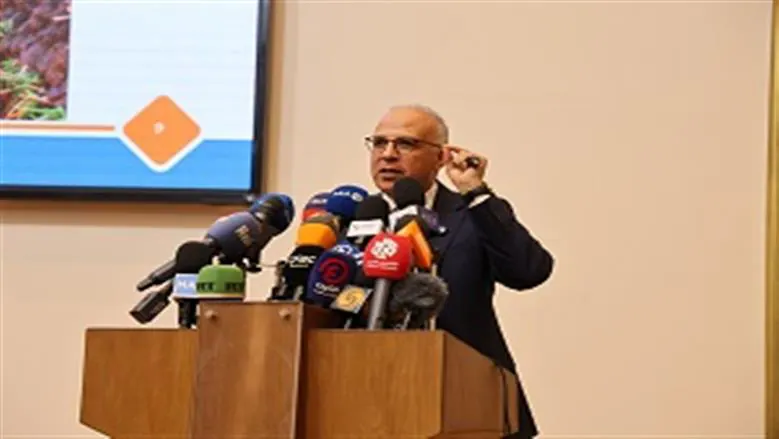
Egyptian Water Resources and Irrigation Minister Hani Suwelim has stated that Egypt's water security is a matter of national importance. The country is closely monitoring the water situation and has advanced systems for monitoring, forecasting, and planning. Suwelim made these remarks during a briefing with foreign media, highlighting Egypt's commitment to protecting its water interests. He emphasized that the country's water security is a top priority that cannot be compromised.
Suwelim pointed out that Egypt's high population density and limited water resources make its water situation unique. He noted that the country relies almost entirely on the Nile River for its water needs. The minister stressed that Egypt's share of the Nile's waters, which stands at 55.5 billion cubic meters, represents only 2.7% of the total rainfall in the Nile basin. This, he said, is a relatively small portion of the available water resources.
The minister provided data on the water resources of other Nile basin countries, including Ethiopia. He mentioned that Ethiopia received over 1,000 billion cubic meters of rainfall in 2023, with 467 billion cubic meters falling within the Ethiopian part of the Nile basin. Suwelim also noted that Ethiopia's renewable water resources are estimated to be around 122 billion cubic meters per year. He highlighted that these resources are replenished annually, unlike Egypt's groundwater, which is a non-renewable resource.
Suwelim discussed the development of Ethiopia's water resources, stating that it does not solely depend on controlling the Blue Nile's waters. He noted that large areas of Ethiopian agricultural land rely on rain-fed farming and groundwater. Regarding the Grand Ethiopian Renaissance Dam (GERD), Suwelim reiterated Egypt's position that the unilateral construction, filling, and operation of the dam contravenes international law.
The minister expressed concerns about the GERD's impact on Egypt and Sudan, the downstream countries. He stated that the dam's operation has shown that it can cause sudden changes in water flows, potentially leading to artificial floods or droughts. Suwelim emphasized that Egypt rejects any attempts at unilateral control over the Nile's waters and stresses the importance of cooperation and adherence to international law.
Suwelim highlighted Egypt's support for development in Nile basin countries, provided that it is based on international law. He cited examples of successful cooperation, such as the Julius Nyerere Dam in Tanzania, which demonstrates how collaborative projects can benefit all parties involved. The minister also emphasized the importance of the Nile Basin Initiative as a framework for cooperation among basin countries.
Suwelim concluded by reaffirming Egypt's commitment to protecting its water interests and rights. He stated that Egypt will not accept any new realities imposed on the Eastern Nile and will continue to manage its water resources using advanced scientific and technical systems. The minister emphasized that Egypt's position is based on supporting the development of Nile basin countries while adhering to international law and rejecting unilateral actions.
Key points
- Egypt's Water Resources and Irrigation Minister Hani Suwelim emphasizes that the country's water security is a national priority that cannot be compromised.
- Suwelim highlights that Egypt's share of the Nile's waters represents only 2.7% of the total rainfall in the Nile basin.
- Egypt rejects any attempts at unilateral control over the Nile's waters, stressing the importance of cooperation and adherence to international law.