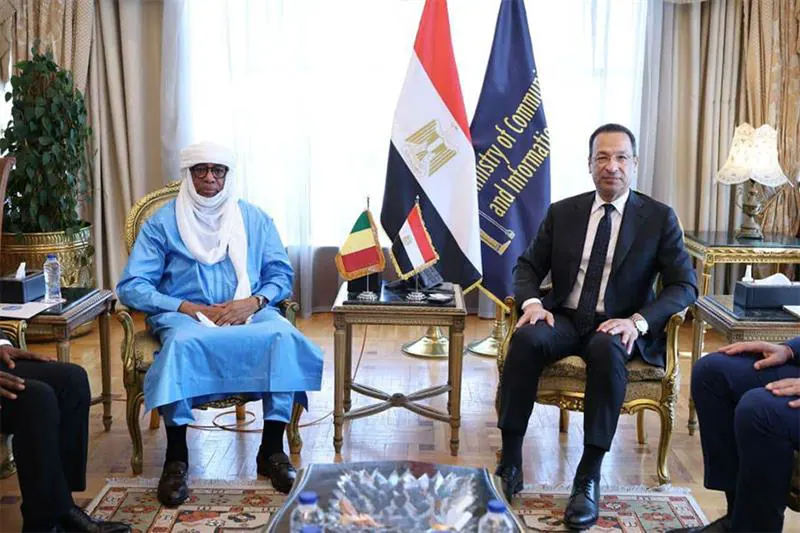
Egypt and Mali are set to enhance their cooperation in the information and communication technology (ICT) sector, focusing on digital transformation, infrastructure development, and capacity building for government services. This was announced during a meeting between Egyptian Minister of Information and Communication Technology Raafat Hindy and Mali’s Minister of Communications, Digital Economy and Administration Modernization Alhamdou Ag Ilyene. The two countries aim to exchange expertise and build digital capacity through training programs.
The Egyptian African Telecom Regulatory Training Centre (EG-ATRC) will play a key role in this cooperation, offering year-round training programs for African professionals. As a regional facility affiliated with Egypt’s National Telecommunications Regulatory Authority (NTRA), EG-ATRC is Africa’s first training centre dedicated to telecommunications regulation. It helps build technical and regulatory capabilities of telecom authorities, professionals, and governments across African and Arab countries.
Egypt’s ICT sector has experienced significant growth over the last 12 fiscal years, increasing by EGP 26.94 billion to reach EGP 27.69 billion in 2024/2025. The sector has been one of the fastest-growing in the country’s economy. Egypt is advocating for stronger ties and mutually beneficial partnerships with other African countries in digital transformation, cybersecurity, and Artificial Intelligence (AI) to modernize digital infrastructure and advance digital integration across the continent.
The meeting between Hindy and Ilyene covered potential cooperation areas, including connecting government institutions, improving regional and international connectivity, and using AI to develop government services. These efforts align with Mali’s plans to modernize its administration and expand digital government services. Mali intends to draw on Egypt’s ICT expertise to develop its government digital infrastructure and institutions, according to Ilyene.
Egypt’s experience in deploying fibre-optic networks was also discussed, particularly through its Decent Life initiative, which established fibre-optic cables to provide high-speed internet services to approximately 60 million citizens in rural areas. In Egypt, the number of homes connected to fibre-optic cables rose by 43.46 percent to approximately 4.39 million in 2024. Mali expressed interest in drawing on Egypt’s experience in this area.
The National Artificial Intelligence (AI) Strategy and the efforts of the Applied Innovation Centre (AIC) were highlighted by Hindy as key pillars of Egypt’s AI development. The strategy aims to develop Egypt’s AI ecosystem, improve data infrastructure, stimulate innovation, and expand the use of AI across economic and government activities. Egypt has been working with other African countries, such as Ghana and Tanzania, sharing its expertise in AI and digital transformation.
Egypt has made significant progress in AI readiness, ranking first in Africa and 51st globally among 195 countries in the 2025 Government Artificial Intelligence (AI) Readiness Index. The country also ranked 22nd globally in the World Bank Group’s GovTech Maturity Index (GTMI). These rankings reflect Egypt’s efforts to develop its digital economy and government-led digital transformation by expanding infrastructure and connectivity to increase the use of digital government services.
Key points
- Egypt and Mali to cooperate on digital transformation and government services.
- Egypt's ICT sector has grown significantly over the last 12 fiscal years.
- Egypt and Mali to exchange expertise on AI and digital infrastructure development.