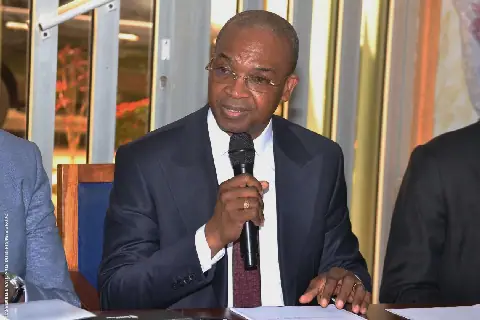
Egypt's Minister of Investment and Foreign Trade, Mohamed Farid Saleh, recently spoke at a plenary session of the Senate about the country's plans to leverage artificial intelligence (AI) to enhance its economic competitiveness. The session, chaired by Senator Essam Eddine Farid, focused on a report examining the strategic use of AI in managing the economy and public finances. Saleh emphasized the importance of this study and the discussions surrounding AI's potential to modernize economic management and improve state institution efficiency.
Saleh stressed the need to differentiate between using global AI applications and developing national capacities to build a sovereign AI ecosystem. This ecosystem relies on three fundamental levels: infrastructure, models, and applications. The first level includes data centers, energy sources, servers, electronic chips, and computing capacities. He highlighted the importance of developing these foundational elements to support the growth of AI in Egypt.
The second level involves developing AI models, particularly large language models and quantitative models, and utilizing historical and statistical data for analysis, forecasting, and economic decision-making. Saleh emphasized the significance of creating linguistic models trained on Arabic content, which would enable more effective application of AI in the Egyptian context.
The third level focuses on designing concrete applications and solutions based on these infrastructures and models to generate tangible economic and developmental value. Saleh underlined the importance of coordinating efforts with the National Strategy for Artificial Intelligence. This strategic alignment aims to ensure that AI development in Egypt is comprehensive and well-directed.
Regarding the regulatory framework, Saleh advocated for a balanced approach that adopts necessary legislation and control mechanisms while preserving an environment conducive to innovation and technological progress. He also emphasized the need to consider the nature of applications, associated risks, and their impact on citizens, ensuring that regulations are both effective and flexible.
Saleh highlighted that the quality, accuracy, and integration of data between state institutions, as well as secure data availability, are essential conditions for the success of AI applications and the development of reliable models producing precise results. This data-driven approach will be crucial in harnessing AI's potential to support Egypt's economic goals.
By focusing on these areas, Egypt aims to harness the potential of AI to drive economic growth, improve governance, and enhance the quality of life for its citizens. The integration of AI into various sectors is expected to bring about significant benefits, including increased efficiency, better decision-making, and improved public services.
Key points
- Developing a sovereign AI ecosystem based on infrastructure, models, and applications.
- Creating linguistic models trained on Arabic content to support effective AI application.
- Balancing regulatory frameworks to foster innovation while ensuring control and security.