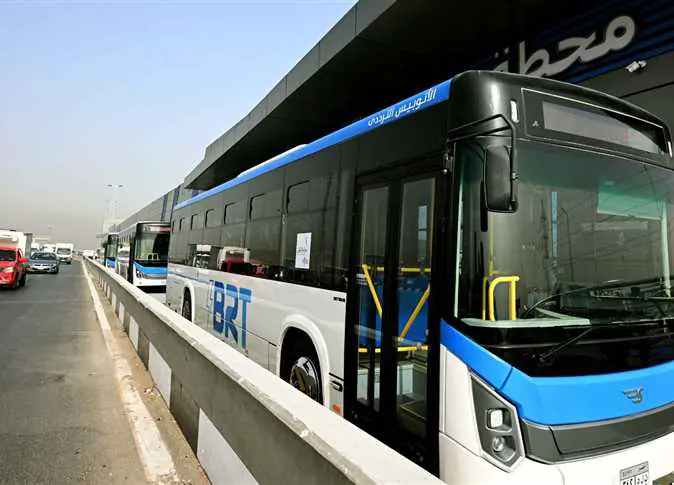
The Egyptian Transport Ministry has announced the launch of public operations for the second phase of the Bus Rapid Transit (BRT) project, effective September 26. This phase covers the route from the Ain Sokhna Road station to the Sun Capital station, extending the BRT network from the intersection of the Ring Road and the Alexandria Agricultural Road to the Sun Capital station. The new phase is a key component of the modern mass transit system serving Greater Cairo.
The second phase of the BRT project spans approximately 40 kilometers and includes 16 stations. The total length of the system, once both phases are operational, will reach around 75 kilometers. This new phase serves several vital areas and corridors across Greater Cairo, including Ain Sokhna Road, Maadi, Mokattam, al-Jazair, al-Imamain, al-Zahraa, al-Bahr al-A’zam, Omraniya, Talbiya, and Maryoutiya, extending to the Sun Capital area.
Ticket prices for the BRT have been set competitively, according to Professor of road and port engineering, Abdullah Abu-Khadra. The prices range from five Egyptian pounds for trips spanning between one and four stations, rising to LE35 for journeys covering 27-30 stations. The full journey across both phases spans approximately 75 kilometers, offering citizens an air-conditioned transport service with regular trips and fixed schedules.
The BRT system represents a significant advancement in Greater Cairo’s mass transit system, according to Abu-Khadra. As a modern, organized, electric-powered mode of transport, the BRT system contributes to alleviating traffic congestion and reducing haphazard traffic movements on the Ring Road. The project is part of a plan to regulate traffic flow on the Ring Road.
The Sun Capital station is a key component of the integrated transport system, situated at the intersection of the Ring Road and Fayoum Road and spanning an area of 80,000 square meters. It facilitates the provision of comprehensive transport services for commuters traveling along the Fayoum Desert Road and the surrounding areas.
The BRT system relies on interchange points that connect it with other modes of transport, enabling passengers to switch between different transport options during a single journey. A prominent example of this integration is the Adly Mansour Station, which connects to Metro Line III and the Light Rail Transit (LRT), alongside other interchange points linking the BRT to various other modes of transportation.
Passengers access and exit BRT stations via pedestrian bridges, tunnels, and elevators, ensuring safe and secure movement between the stations. These measures are part of a plan to regulate traffic flow on the Ring Road, which includes prohibiting direct pedestrian crossings and eliminating informal microbus stops along the route, replacing them with a more organized transport system.
Key points
- The second phase of the BRT project spans approximately 40 kilometers and includes 16 stations.
- The BRT system contributes to alleviating traffic congestion and reducing haphazard traffic movements on the Ring Road.
- The Sun Capital station is a key component of the integrated transport system, facilitating comprehensive transport services for commuters.