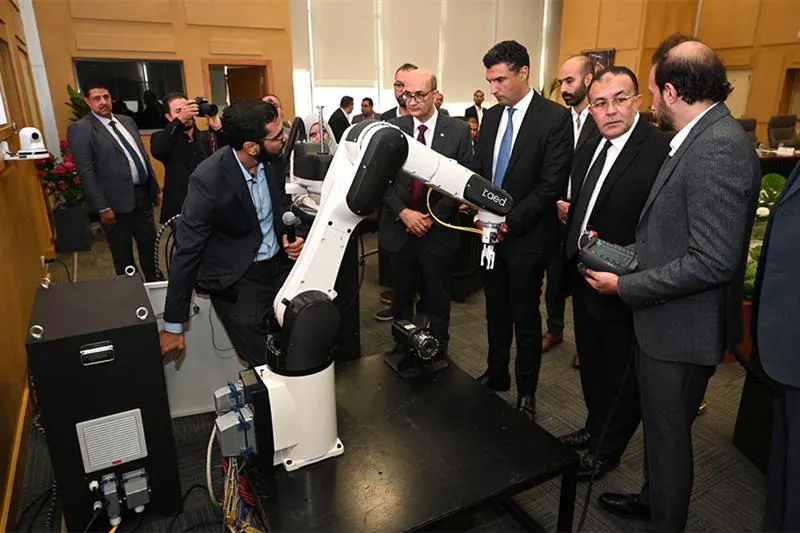
Egypt has successfully launched its first national industrial robot, developed by the Egyptian company Raed Bots, with 80% of its components produced locally. This achievement marks a significant milestone in the country's efforts to enhance its industrial capabilities and reduce reliance on imported technologies. The robot is designed for concrete industrial applications, particularly in packaging and bottling machines.
The development of the robot is a result of collaboration between the Industrial Modernization Centre (IMC), Raed Bots, and Cubii, a company specializing in packaging and bottling machines. Raed Bots, a member of the NVIDIA Inception program, has been working on artificial intelligence-based robots for various industrial applications, including welding, CNC machining, material handling, packaging, and warehousing. These solutions aim to improve productivity, reduce costs, and enhance safety standards in industrial processes.
The Egyptian Minister of Industry, Khaled Hashem, emphasized the importance of believing in local technology and innovation, highlighting the capabilities of Egyptian youth in developing and transforming knowledge into industrial products. He stressed that the robot needs to gain the trust of factories to increase their reliance on locally manufactured robots. The minister also mentioned that the project aligns with the country's strategy to localize the machine and production line industries.
Three cooperation protocols were signed between various entities to support the development and application of the robot. These include an agreement between the IMC and Raed Bots to provide technical support to industrial establishments, a partnership between Raed Bots and Cubii to develop robots for packaging and bottling machines, and a collaboration between Raed Bots and the Faculty of Engineering at Mansoura University to provide educational robots for research and training purposes.
The Egyptian government aims to increase the local component percentage of the robot to 90% once the motors are manufactured locally. Minister Hashem emphasized the ministry's focus on localizing the machine and production line industries, which are considered enabling industries in the Egyptian industrial strategy. The goal is to deepen local manufacturing, enhance industrial competitiveness, and create new opportunities for Egyptian youth.
The launch of the robot is seen as a step towards transforming the concept of "Made in Egypt" into industries that provide solutions and facilitate the production of other sectors, anchoring them in global supply chains. The robot is expected to improve productivity, reduce costs, and enhance safety standards in industrial processes. The development of local industries and technologies is a key aspect of Egypt's economic strategy.
The Egyptian government is committed to supporting innovation and local industries, with a focus on artificial intelligence, data centers, and other emerging technologies. The launch of the national industrial robot is a significant achievement in this regard, demonstrating the country's capabilities in developing cutting-edge technologies. The government aims to create a favorable business environment that encourages investment and innovation.
Key points
- Egypt has launched its first national industrial robot with 80% local components.
- The robot is designed for concrete industrial applications, particularly in packaging and bottling machines.
- The government aims to increase the local component percentage of the robot to 90% once the motors are manufactured locally.