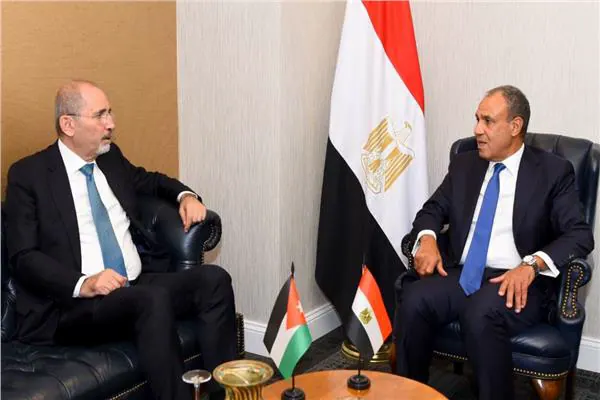
Egyptian Foreign Minister Badr Abdelatty met with his Jordanian counterpart, Ayman Safadi, on the sidelines of the 81st United Nations General Assembly in New York. The two ministers emphasized the depth and uniqueness of Egyptian-Jordanian relations, expressing their commitment to further enhancing bilateral cooperation. They also discussed ways to promote trilateral cooperation between Egypt, Jordan, and Iraq, aiming to achieve mutual benefits for the three nations.
The meeting covered recent developments in the Palestinian issue, including efforts to complete the implementation of the US-led peace plan and stabilize the Gaza Strip. The ministers also discussed the situation in the West Bank, stressing the need to ensure the delivery of humanitarian aid. Both Abdelatty and Safadi reiterated their rejection of Israeli annexation and settlement policies, as well as violence perpetrated by settlers.
The Egyptian and Jordanian foreign ministers emphasized the importance of maintaining the historical and legal status quo in Jerusalem. Abdelatty reaffirmed Egypt's support for Jordan's custodianship over Islamic and Christian holy sites in the city. The two ministers also exchanged views on regional developments, highlighting the need for de-escalation and respect for state sovereignty and territorial integrity.
Abdelatty and Safadi condemned Iranian attacks targeting Jordan and other Arab countries, with Abdelatty expressing Egypt's full solidarity with Jordan in the face of any aggression threatening its security and sovereignty. The ministers also discussed ways to enhance coordination on Arab issues at the United Nations.
The meeting between Abdelatty and Safadi took place on September 22, 2026, as part of the high-level segment of the UN General Assembly. The two ministers were joined by Egyptian Foreign Ministry spokesperson Nader Zaki, who provided insights into the discussions. Egypt and Jordan have a long-standing relationship, with regular high-level exchanges on regional and international issues.
The Palestinian issue remains a central concern for both Egypt and Jordan, with the two countries playing key roles in regional efforts to address the crisis. Abdelatty and Safadi stressed the need for a comprehensive and sustainable solution to the conflict, based on international law and relevant UN resolutions.
The Egyptian-Jordanian coordination on regional issues is seen as crucial in promoting stability and security in the Middle East. The two countries have consistently supported each other's positions on key issues, including the Palestinian question and the fight against terrorism. KEY_POINT: Egypt and Jordan reject Israeli annexation and settlement policies. KEY_POINT: The two countries stress the importance of maintaining the historical and legal status quo in Jerusalem. KEY_POINT: Egypt and Jordan condemn Iranian attacks targeting Jordan and other Arab countries.