Egyptian Irrigation Minister Hani Sewilam stated that building a dam on an international river like the Nile is not comparable to laying a carpet in one's home. He emphasized that there is a significant difference between constructing a school within a country's borders and building a dam on a shared international river, which is governed by international law. Sewilam's comments were in response to Ethiopia's assertion that constructing dams on the Nile falls exclusively within its sovereignty.
Sewilam questioned the origin of the idea that a country has a sovereign right to build dams on a river shared by 10 countries. He described this notion as a "new religion" being advocated by Ethiopian politicians. The minister's remarks countered those of Ethiopian Water and Energy Minister Habtamu Itefa, who recently asserted Ethiopia's sovereign right to develop the Blue Nile and build further dams as needed. Itefa also accused Cairo of opposing Ethiopian development, which Egyptian officials deny.
Egyptian officials have warned that additional Ethiopian dams could give Addis Ababa greater control over the timing and volume of water reaching downstream Egypt and Sudan. Sewilam described Itefa's statement that new Blue Nile dams would give Addis Ababa control over downstream flows as an "extremely serious" admission. He noted that this remark represents a "qualitative shift" in Ethiopia's language regarding the dams.
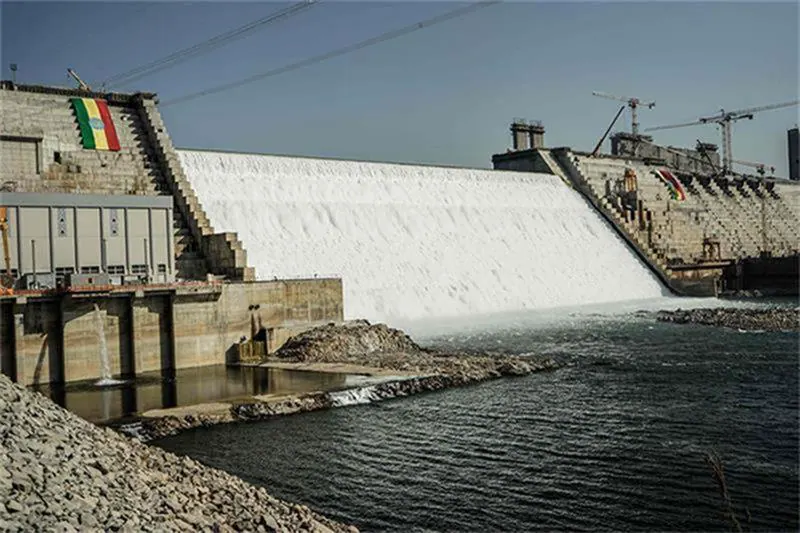
Sewilam also questioned whether electricity generated by the Grand Ethiopian Renaissance Dam (GERD) was reaching ordinary Ethiopians or being used for other purposes, such as Bitcoin mining. He asked whether the Ethiopian people had received electricity as promised, given that they had spent 15 years waiting for it. The GERD was formally inaugurated in September 2025 after filling its reservoir in stages between 2020 and 2024 without a binding agreement with Egypt and Sudan.
Egypt and Sudan have sought a legally binding agreement governing GERD filling and operation, particularly during prolonged drought, as well as rules covering dam safety, water releases, dispute settlement, and data exchange. Cairo stressed that the absence of operational data has left Sudanese dam operators facing unpredictable flows and has exposed both downstream countries to alternating risks of water shortages and uncontrolled flooding.
Ethiopia claims that the hydropower project is essential to its development and will not significantly harm the downstream countries. However, Egypt depends on the Nile for more than 90 percent of its freshwater, while the Blue Nile supplies about 85 percent of the 55.5 billion cubic meters it receives annually. Egyptian Foreign Minister Badr Abdelatty recently reaffirmed Egypt's rejection of unilateral Nile measures and called for an inclusive Nile Basin Initiative governed by consensus and international law.
The issue remains a point of contention between Egypt and Ethiopia, with Egypt pushing for a resolution that prioritizes the interests of all Nile Basin countries. Greece and Cyprus have also expressed support for Egypt's water security and urged full compliance with international law in managing the Nile Basin. Egypt retains all lawful options to protect its Nile water security, according to the Irrigation minister.
Key points
- Egypt's Irrigation Minister Hani Sewilam criticizes Ethiopia's stance on building dams on the Nile River.
- Sewilam questions the origin of the idea that a country has a sovereign right to build dams on a shared river.
- Egypt and Sudan seek a legally binding agreement governing GERD filling and operation to ensure water security.