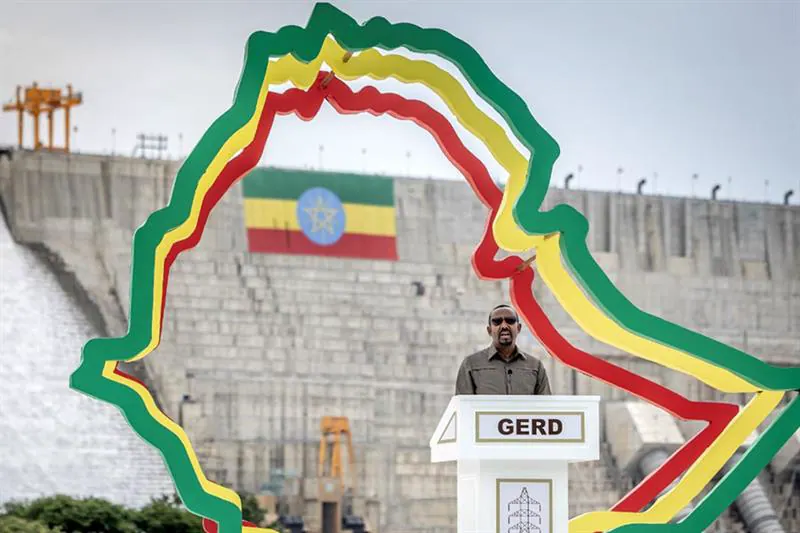
Ethiopia has announced plans to build three new hydroelectric dams on the Blue Nile, sparking concerns from Egypt over water security and the country's unilateral decision-making. The new dams are intended to meet Ethiopia's energy needs and export surplus electricity. Egypt's Minister of Foreign Affairs, Badr Abdelatty, rejected the move, stating that Egypt reserves the right to self-defense under international law.
The dispute over the dams comes as Egypt faces significant water scarcity challenges, with the Nile River being its primary source of freshwater. The Blue Nile provides around 85% of Egypt's water supply, with a per capita water availability of approximately 600 cubic meters per year, well below the UN's poverty threshold of 1,000 cubic meters. Egypt requires notification and coordination with downstream countries for any projects that may impact the Nile's flow.
Former Egyptian Minister of Irrigation, Mohamed Nasr Eddine Allam, warned that the construction of three additional dams could exacerbate Egypt's water scarcity, potentially leading to drought and famine. Allam estimated that the dams could deprive Egypt of its water quota for three to four years. Egypt's concerns extend beyond the dams themselves, as they question Ethiopia's approach to decision-making on the Nile River.
Egypt criticizes Ethiopia for prioritizing unilateral decisions over negotiations with downstream countries, a pattern that began with the construction of the Grand Ethiopian Renaissance Dam (GERD). The GERD has been a point of contention between Egypt, Ethiopia, and Sudan, with Egypt and Sudan expressing concerns over the dam's impact on their water security. Egypt's concerns have been echoed by experts, who argue that Ethiopia's actions may be driven by a desire to exert pressure on downstream countries.
According to Mohamed Abdel-Kérim, a specialist in African affairs, Ethiopia's actions demonstrate a clear political agenda. Abdel-Kérim noted that Ethiopia's statements on controlling the flow of the Nile River toward Egypt and Sudan reveal a desire to use water as a tool for exerting pressure. This approach has raised concerns in Egypt, where the government is keen to prevent unilateral decisions from becoming a new reality on the Nile River.
The dispute between Egypt and Ethiopia occurs within a tense regional context, marked by rivalries in the Horn of Africa and around the Red Sea. Egypt has strengthened its relations with Somalia and Eritrea while reaffirming its support for Sudan's sovereignty and unity. Abdel-Kérim suggested that Ethiopia's new projects may be coordinated with other regional states with converging interests.
Ethiopia claims that the three new dams will be smaller than the GERD and will take seven years to construct. However, Egypt maintains that any project affecting the Nile's flow must be preceded by notification and coordination with downstream countries. For Egypt, the goal is to prevent unilateral decisions from becoming a new reality on the Nile River, ensuring that the country's water security is protected.
Key points
- Egypt criticizes Ethiopia's plan to build three new hydroelectric dams on the Blue Nile, citing concerns over water security and unilateral decision-making.
- The dispute between Egypt and Ethiopia occurs within a tense regional context, marked by rivalries in the Horn of Africa and around the Red Sea.
- Egypt requires notification and coordination with downstream countries for any projects that may impact the Nile's flow.