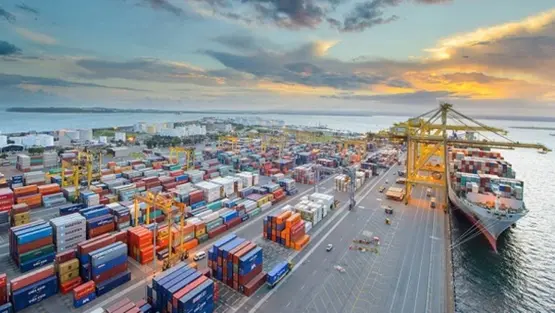
Egypt's Minister of Transport, Kamel Al-Wazir, announced the development of eight integrated international logistics corridors. These corridors will link seaports on the Red Sea and Mediterranean with the Suez Canal, dry ports, and industrial, agricultural, and mining zones. The project aims to connect Egypt with markets in the Gulf, the Levant, Africa, Europe, and Asia through railways, the electric high-speed rail network, and highways.
The eight logistics corridors are strategically located across Egypt. They include the Arish–Taba, Sokhna–Alexandria, Safaga–Qena–Abu Tartour, Cairo–Alexandria, Tanta–Mansoura–Damietta, Gargoub–Salloum, Cairo–Aswan–Abu Simbel, and Bernice–Aswan–East Oweinat–Kufra–N’Djamena corridors. These corridors are expected to reduce cargo handling times and logistics costs, making Egypt a more attractive location for trade and investment.
The Egyptian government's maritime transport development plan aims to turn Egyptian ports into integrated logistics hubs. The plan includes developing ports on the Red Sea and Mediterranean, establishing five new ports to bring the total number of commercial ports to 19, and expanding port areas to 100 million square meters. This expansion will enable Egyptian ports to handle increased trade volumes and improve the country's competitiveness in the global market.
The maritime transport development plan also involves significant investments in port infrastructure. The plan includes adding 70 kilometers of new berths with depths ranging from 18 to 25 meters, bringing the total berth length to more than 100 kilometers. Additionally, the plan calls for the construction of 35 kilometers of breakwaters, taking the total to 50 kilometers, as well as the development of navigation channels and expansion of the marine tug fleet to 80 vessels.
Egyptian ports have shown significant growth in recent years. In 2025, the ports handled 233 million tonnes of cargo, up 12% from the previous year. Container throughput reached 11.1 million TEUs, representing a 25% annual increase. This growth is attributed to investments in container and multipurpose terminals, including projects offered to international shipping lines and global operators for infrastructure development, operation, and management.
Egypt has also improved its position in the United Nations Conference on Trade and Development's Liner Shipping Connectivity Index (LSCI). The country rose to 19th globally in 2025 from 23rd in 2024. Egypt ranked first in Africa and second among Arab countries, with the government targeting a position among the world's top 15 countries by 2030. The government is working to expand port infrastructure and operating capacity and attract major shipping lines, including Maersk, MSC, and CMA CGM.
The Egyptian government is also working to expand its commercial maritime fleet and align its maritime sector with international agreements and IMO instruments. The Transport Ministry aims to increase the fleet to around 40 vessels by 2030, capable of transporting 30 million tonnes of cargo annually. The ministry is also pursuing measures to reduce emissions from maritime transport, including the development of green ports, shore-side electricity services, and the use of lower-emission marine fuels.
Key points
- Egypt implements eight logistics corridors to boost transport and transit trade.
- The corridors aim to connect Egypt with markets in the Gulf, the Levant, Africa, Europe, and Asia.
- Egyptian ports handled 233 million tonnes of cargo in 2025, up 12% from the previous year.