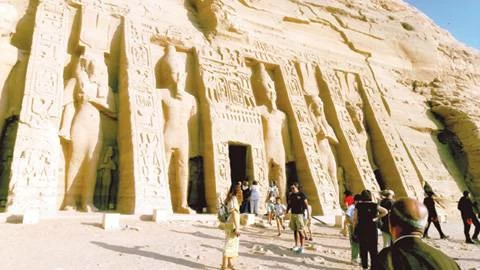
Today, Egypt commemorates the 58th anniversary of the successful rescue of the Abu Simbel Temple, a monumental feat of engineering and archaeological preservation. The temple, located in the southern part of Egypt, was threatened by the rising waters of Lake Nasser following the construction of the Aswan High Dam. The rescue operation, which began in 1964 and was completed on September 22, 1968, was a complex and challenging endeavor that required innovative solutions to save the ancient temple from destruction.
The Abu Simbel Temple, built during the reign of Pharaoh Ramses II, is one of the most impressive architectural achievements in Egypt. The temple, carved into the mountainside, was a massive structure that weighed over 50,000 tons. The rescue team, led by Dr. Zahi Hawass, a renowned Egyptian archaeologist, and Nasser Salah, the former director of the Aswan and Nubia Antiquities, faced significant technical challenges in dismantling and reassembling the temple. The team had to develop specialized equipment and techniques to cut and move the massive stone blocks without causing damage to the temple.
The rescue operation involved a team of over 2,000 Egyptian workers who worked tirelessly to dismantle the temple into over 1,000 blocks, each weighing between 20 and 30 tons. The blocks were then transported to a new site, where the temple was reassembled using a combination of traditional and modern techniques. The operation was an international effort, with UNESCO providing significant financial and technical support. The successful rescue of the Abu Simbel Temple was hailed as one of the greatest archaeological achievements of the 20th century.
The construction of the Aswan High Dam, which began in 1959, posed a significant threat to the ancient temples of Nubia, including the Abu Simbel Temple. The dam's reservoir, Lake Nasser, was expected to flood the temples, erasing centuries of history and culture. The Egyptian government, with the help of UNESCO, launched a massive campaign to rescue the temples, which included the relocation of the Abu Simbel Temple to a higher site.
The relocation of the Abu Simbel Temple was a painstaking process that required meticulous planning and execution. The team had to carefully document and record every aspect of the temple, including its intricate carvings and paintings, to ensure that the reassembled temple would be as accurate and complete as possible. The rescue operation was not without its challenges, however, as the team faced numerous technical and logistical difficulties, including the risk of damage to the temple and the safety of the workers.
The successful rescue of the Abu Simbel Temple was a testament to the ingenuity and determination of the Egyptian people and the international community. The temple, which was originally built to honor the gods Amun and Ra, was reopened on September 22, 1968, and has since become one of Egypt's most popular tourist attractions. The rescue operation also highlighted the importance of preserving cultural heritage and the need for international cooperation to protect our shared cultural and historical legacy.
Today, the Abu Simbel Temple is a UNESCO World Heritage site, recognized for its cultural and historical significance. The temple's rescue is celebrated as a major achievement in the field of archaeology and cultural preservation. As Egypt continues to celebrate the 58th anniversary of the temple's rescue, it also reaffirms its commitment to preserving its rich cultural heritage for future generations.
Key points
- The rescue of the Abu Simbel Temple was a complex and challenging operation that required innovative solutions to save the ancient temple from destruction.
- The operation involved a team of over 2,000 Egyptian workers who worked tirelessly to dismantle the temple into over 1,000 blocks.
- The successful rescue of the Abu Simbel Temple was hailed as one of the greatest archaeological achievements of the 20th century.