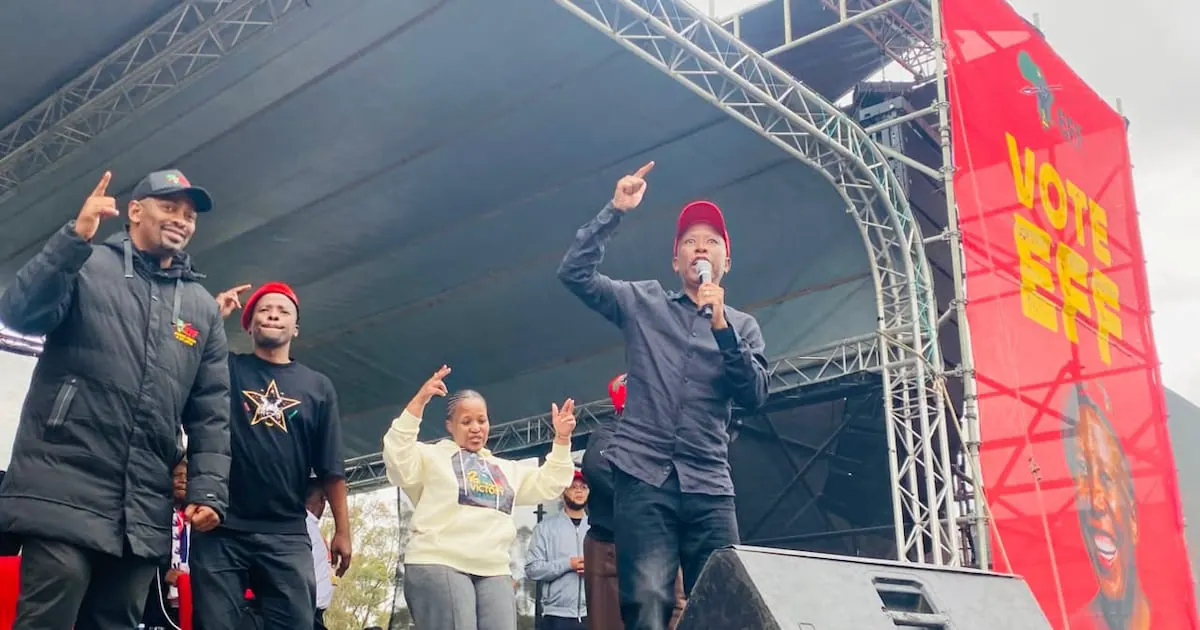
The Economic Freedom Fighters (EFF) has released a manifesto for the upcoming local government elections in South Africa, which seeks to utilize municipalities as tools for economic transformation. The party envisions municipalities playing a more significant role than just collecting refuse, maintaining roads, and providing water. Instead, it aims to leverage municipal land, public services, procurement, and local economic policy to improve the lives of poor communities. This approach is an extension of the EFF's national politics, but it also highlights the challenges the party faces in converting its ideas into votes.
The EFF's ideas have gained significant traction in South African politics, but its electoral performance has been inconsistent. In the 2014 national election, the party secured 6.35% of the vote, which increased to 10.79% in 2019. However, in the 2019 election, the party's growth was hindered by the emergence of the MK Party, which attracted disaffected voters. The EFF's support rose from approximately 8% in 2016 to over 10% in 2021 in local elections. Despite this growth, the party's ideological influence extends beyond its electoral base, with other parties now engaging with issues that the EFF helped bring to the center of national debate.
One of the main challenges facing the EFF is convincing voters to accept the costs associated with its economic transformation agenda. While many South Africans agree with the party's diagnosis of the country's economic problems, there is less consensus on the solutions. The EFF's proposals for land reform, nationalization, and economic transformation are contentious, and the party must navigate these complexities to build a broader electoral coalition. The party's ability to persuade voters to accept the costs of its policies will be crucial in determining its success in the local government elections.
Municipal government presents a unique challenge for the EFF, as it requires practical choices and trade-offs. Expanding free services, for instance, raises questions about eligibility and revenue, while lower tariffs can leave less money available for other priorities. Insourcing municipal services can also put pressure on wage budgets. These decisions can be difficult to make at the national level, but in a struggling municipality, they become a matter of arithmetic. The EFF must balance competing demands and interests, which can be a difficult task, especially in a slow-growing economy.
The EFF's constituency is diverse, with different groups occupying various positions within the economy. Workers may want higher wages, while households may seek lower tariffs. Businesses may prioritize lower costs, and unemployed individuals may require greater access to job opportunities. Poor households may need greater municipal support, but municipalities also rely on stronger revenue collection to maintain infrastructure. The EFF must navigate these competing interests and find a way to build a broader coalition that can support its economic transformation agenda.
The gap between the EFF's ideological influence and its electoral size can be attributed to the challenges of converting its diagnosis into a programme that resonates with voters. The party's programme inevitably asks voters to consider not only what they want changed but also what that change may require of them. In a slow-growing economy, there is limited new wealth to accommodate competing claims, making choices more immediate and politically consequential. The EFF's success in the local government elections will depend on its ability to persuade voters to accept the costs of its policies.
The upcoming local government elections will test the EFF's ability to increase its share of votes and convert its ideas into electoral success. The party's most successful political export may be its diagnosis of South Africa's economic problems, but converting this into votes will be a significant challenge. According to Prof Joseph Sekhampu, the chief director of the NWU Business School, the EFF's ability to persuade voters to accept the costs of its policies will be crucial in determining its success.
Key points
- The EFF faces a challenge in converting its ideas into votes in the local government elections.
- The party's economic transformation agenda is contentious, and it must navigate competing demands and interests to build a broader electoral coalition.
- The EFF's success will depend on its ability to persuade voters to accept the costs associated with its policies.