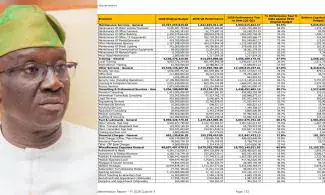
The Edo State government, under Governor Monday Okpebholo, has come under scrutiny for its spending priorities after allocating large sums to refreshments and welfare packages. According to Sahara Reporters' analysis of the Edo State Government's 2026 Third Quarter (Q3) Budget Implementation Report, the government spent ₦2.39 billion on refreshments and meals, and ₦5.02 billion on welfare packages between January and September 2026.
A breakdown of the report showed that the state government spent a cumulative ₦10.08 billion on refreshments, meals, honoraria, sitting allowances, publicity, welfare packages, and sporting activities during the nine-month period. This expenditure exceeded what was spent on primary healthcare and basic education during the same period. The report also revealed that ₦682.55 million was spent on honoraria and sitting allowances, ₦1.66 billion on publicity and advertisements, and ₦337.19 million on sporting activities.
In contrast, the state government's actual spending on basic education within the same nine-month period stood at only ₦1.50 billion, representing 11 per cent of its approved ₦13.63 billion budget. The report further showed that the Edo State government spent ₦7.21 billion on primary healthcare between January and September 2026, representing just 20.5 per cent of the approved ₦35.27 billion allocation for the sector.
The expenditure on refreshments, welfare packages, and other activities has raised questions about the government's spending priorities, particularly as public schools continue to face funding and infrastructure challenges. Families struggle with the cost of accessing quality education and public healthcare facilities for essential services. The figures present a troubling contrast for ordinary residents who depend on government-funded basic education for children and primary healthcare centres for maternal services, immunisation, and treatment of common illnesses.
For parents struggling to educate their children, inadequate school infrastructure, insufficient teaching materials, and poorly equipped classrooms can undermine the future of children who have no realistic alternative to public education. The scale of spending, particularly when compared with the poor execution of essential social-sector budgets, raises questions about value for money, transparency, and the government's priorities.
The report's programme classification shows that only ₦258.43 million was spent on improving the quality of teaching and learning outcomes, against an approved ₦3.07 billion. For infrastructure at all levels, the state recorded approximately ₦785.32 million in expenditure against an allocation of ₦6.5 billion. There was no recorded expenditure against the ₦200 million allocation for equity and inclusiveness in educational services or the ₦200 million approved for improving the Education Information Management System.
According to the report, Edo State approved ₦35.27 billion for primary healthcare in 2026, but by the end of the third quarter, only ₦7.21 billion had been recorded as actual expenditure, leaving approximately ₦28.05 billion unspent against the original allocation. The report's functional classification further revealed that expenditure on pharmaceutical products stood at zero against an approved allocation of ₦1.005 billion.
Key points
- The Edo State government spent ₦10.08 billion on refreshments, meals, honoraria, sitting allowances, publicity, welfare packages, and sporting activities between January and September 2026.
- Basic education received only ₦1.5 billion, representing 11 per cent of its approved ₦13.63 billion budget, during the same nine-month period.
- The state's primary healthcare sector received ₦7.21 billion, representing 20.5 per cent of its approved ₦35.27 billion allocation, between January and September 2026.