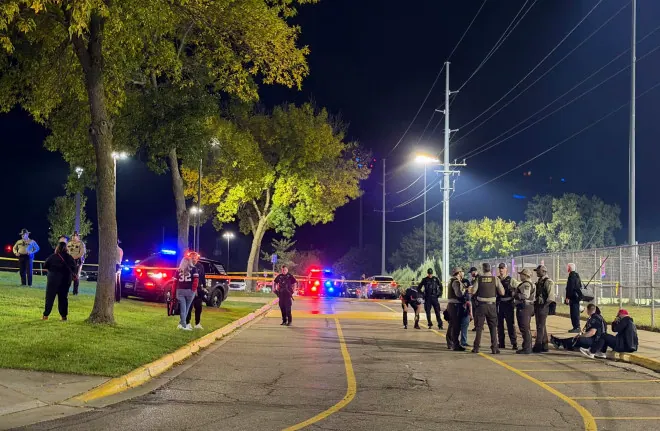
A recent shooting at Eden Prairie High School's homecoming football game has sparked concerns about gang violence in the Twin Cities, specifically in the Somali community. The incident prompted an evacuation of the school and is being investigated by the Eden Prairie police. According to police, there was a large altercation west of the school's Aerie Stadium before the shooting, and several people were removed from the grounds. Moments later, someone reported gunfire in the school's parking lot.
The shooting has reignited a heated discussion about gang violence in the Somali community, with some arguing that it's necessary to acknowledge the involvement of Somali teens and young adults in the violence. Ramsey County Sheriff Bob Fletcher has been vocal about the issue, stating that a small number of Somali teens and young adults are responsible for a large number of gang shootings in Minnesota. Fletcher estimates that around 300 children and young adults participate in gang activity out of a Somali population of over 100,000 in Minnesota.
However, others, including some Islamic groups and community leaders, argue that singling out the Somali community is stigmatizing and feeds into broader racism against Somalis. They say that the issue of youth violence should be viewed as a larger community- and nation-wide problem with gun violence. Imam Sheik Hassan Dhooye, a Minneapolis Imam, spoke out after the shooting, saying that "enough is enough" with youth violence in the Somali community and that the problem should not be used for political gain or to label an entire community.
The city of Edina, which has also seen similar incidents, hosted a community meeting to address gun violence. Edina Police Chief Todd Milburn posted a video on September 24 addressing two recent shootings that involved Somali teens as victims or suspects. Milburn stated that the shootings aligned with a pattern of gang violence, but also emphasized that the department did not know who was responsible for the shootings. The chief's statement was careful not to use the term "Somali gangs."
At the community meeting in Edina, officials emphasized that the problems were not centered on any one community. Edina Mayor Jim Hovland stated that the city is concerned about conduct, not ethnicity, national origin, or religion. Many members of the public who spoke at the event, including some from the East African community, said that group-based violence is not unique to their community and that discussions about the issue have contributed to harmful rhetoric.
Some community members, such as Abdirahman Abdi, an Edina resident, expressed concern that mentioning the Somali name every time something happens is not safe and will not solve any problems. Imam Hassan Jama of the Alhikma Islamic Center also criticized Sheriff Fletcher for singling out Somali gangs specifically, saying that he wants to see "crime as crime" rather than focusing on it happening among a particular ethnicity.
The topic of Somali gangs gained more media attention in July when Sheriff Fletcher described his office's work to address the ongoing challenges and traumatic incidents linked to 12 different organized groups. Fletcher defended his decision to raise the issue, stating that it's a problem that has been monitored for two years and is exponentially increasing. The issue remains a contentious topic in the Twin Cities, with many calling for a nuanced approach to addressing gang violence.
Key points
- The shooting at Eden Prairie High School has renewed concerns about gang violence in the Somali community.
- Some argue that singling out the Somali community is stigmatizing and feeds into broader racism against Somalis.
- Officials emphasize that the problems are not centered on any one community and that discussions about the issue should be careful not to perpetuate harmful rhetoric.