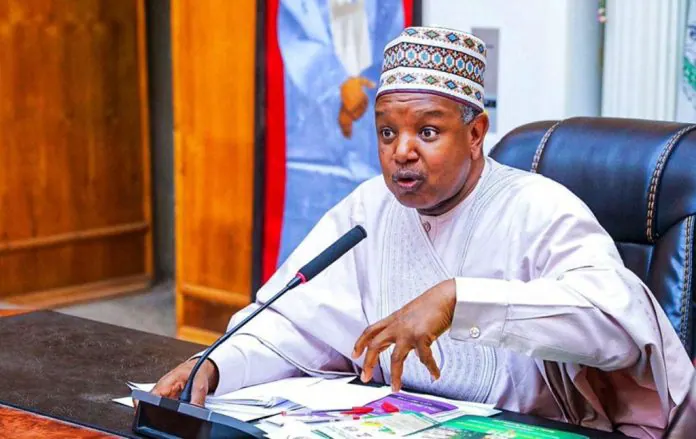
Nigeria's Budget and Economic Planning Minister, Senator Abubakar Atiku Bagudu, has warned that the country's economy is currently too small to meet its development needs. He made this statement at a capacity-building workshop organised by the Senate Press Corps in Abuja. The minister noted that Nigeria's low revenue-to-GDP ratio has constrained its spending capacity, making it challenging to achieve development goals.
According to Bagudu, Nigeria has the smallest national budget among the 10 most populous countries in the world. The countries include India, China, the United States, Indonesia, Pakistan, Brazil, Bangladesh, Russia, and Ethiopia. Nigeria's 2026 budget is N68.32 trillion, which is about $49 billion, the highest in recent years. However, the minister noted that the country's budget is still too small to support its growth needs.
Bagudu cited Brazil as a more relevant benchmark for Nigeria, saying the South American country has a population comparable to Nigeria and operates a federal system involving federal, state, and municipal governments. Brazil's 2025 federal budget is at least 25 times the size of Nigeria's budget. The minister stressed that Nigeria must build public understanding around the need to mobilise more resources for development.
The minister explained that President Bola Tinubu's administration is working towards a $1 trillion economy, building on the country's Agenda 2050 aspirations, which target a GDP per capita of more than $30,000 by 2050. Achieving such ambitions will require greater revenue mobilisation, investment, and, where necessary, borrowing supported by public confidence.
Bagudu urged the media to help Nigerians understand the rationale behind budget provisions rather than drawing conclusions without adequate verification. He cautioned against automatically describing unfamiliar budget items as unlawful insertions, explaining that some provisions could reflect genuine needs in communities.
The Chairman of the Senate Committee on Media and Public Affairs, Senator Yemi Adaramodu, who represented the Senate President, Senator Godswill Akpabio, said the media had a responsibility to scrutinise the budget and its implementation, while warning against misinformation about public finances. The lawmaker called for balanced reportage to sustain public confidence in the budget.
Experts, including Ebu Emmanuel, who represented the Executive Director of the Civil Society Legislative and Advocacy Centre (CISLAC), Auwal Musa Rafsanjani, and the Director of BudgIT, Oluseun Onigbinde, also spoke at the workshop. They emphasised the need for justified, transparent, properly costed, and measurable budget provisions, as well as legislative budget scrutiny focused on public policy performance.
Key points
- Nigeria's economy is too small to meet its development needs.
- The country's low revenue-to-GDP ratio has constrained its spending capacity.
- The government aims to achieve a $1 trillion economy by building on the country's Agenda 2050 aspirations.