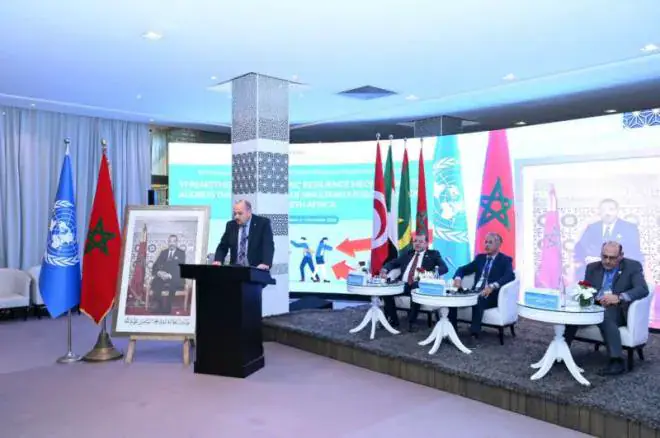
The 41st session of the Intergovernmental Committee of Senior Officials and Experts for North Africa kicked off in Rabat, Morocco, with Tunisia participating. The meeting, which runs until November 5, has the theme "Strengthening Economic Resilience Mechanisms to Address the Impact of Concurrent Global Shocks in North Africa." The session brings together government officials, representatives from regional and international institutions, experts, and specialists.
Nasim Oulmann, Director of the North Africa Regional Office of the Economic Commission for Africa (ECA), called for developing economic resilience approaches in the region. He emphasized the need to shift from responding to crises to anticipating them and moving from national to regional solutions. Oulmann also stressed the importance of moving beyond short-term stabilization to achieving long-term economic transformation.
According to Oulmann, North African countries have shown resilience in the face of global shocks, including the COVID-19 pandemic, the war in Ukraine, and extreme climate events. The region's economic growth rate reached 4.6% in 2025, up from 1.1% in 2024, driven by increased oil production in Libya, expanded economic activity in Algeria and Egypt, and positive growth in Morocco and Sudan.
Tarik Bohlal, Director General of African Cooperation at the Tunisian Ministry of Economy and Planning, highlighted the importance of enhancing Africa's financial sovereignty. He emphasized the need for African countries to develop their financial independence, improve local and regional resource mobilization, and enhance cooperation between financial institutions.
Bohlal also called for the implementation of the African Continental Free Trade Area (AfCFTA) agreement, which aims to improve regional infrastructure connectivity, promote intra-African trade and investment, and reduce economic and financial fragmentation. He stressed the need for a stronger African voice in international forums, particularly on issues related to financial system reform and climate change.
Zahreddine Balbshir, representative of the Arab Maghreb Union, emphasized that economic resilience requires a shared vision and collective will, based on strengthened cooperation, exchange of best practices, and mobilization of available resources. He called for recommendations that would enhance North African countries' ability to face global shocks and achieve more diversified, sustainable, and inclusive economic growth.
The meeting, organized by the North Africa Regional Office of the ECA, aims to exchange best practices and explore innovative policies to enhance regional economic resilience. The session's outcomes are expected to support the implementation of the 2030 Sustainable Development Goals and Agenda 2063, and to promote economic transformation and diversification in North Africa.
Key points
- The 41st UNECA meeting focuses on strengthening economic resilience in North Africa.
- The region's economic growth rate reached 4.6% in 2025, driven by increased oil production and expanded economic activity.
- The meeting aims to promote regional cooperation and exchange best practices to address global shocks.