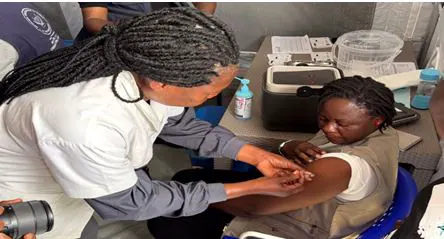
A new study aimed at documenting the voluntary vaccination of 20,000 healthcare workers has been launched in the Democratic Republic of Congo (DRC) by Medecins Sans Frontieres (MSF). The study, dubbed "Bravo," seeks to assess the use and potential effectiveness of the ERVEBO vaccine in real-world outbreak conditions. The research will focus on healthcare workers in the Ituri and North Kivu provinces, who are at high risk of contracting the Bundibugyo virus.
The study was launched on September 19, 2026, in Bunia and will run for six months, with the first three months dedicated to vaccination. Participation and vaccine administration are based on voluntary consent. According to MSF, the vaccine is not a replacement for proven infection prevention and control measures but rather a complementary protection measure to enhance the response to the outbreak.
The Bundibugyo virus outbreak continues to affect several health zones in the DRC. MSF reports that several vaccines specifically developed against the virus are still under development and may become available in the coming months. In the meantime, the ERVEBO vaccine is being offered as a temporary measure to bolster protection for healthcare workers who are particularly exposed to the outbreak.
The study is being conducted in collaboration with the Ministry of Health, Africa CDC, and several scientific partners. Dr. Guyguy Manangama, MSF's deputy operations director and epidemiologist, explained that the research aims to document the vaccination of healthcare workers to evaluate the use and potential effectiveness of the ERVEBO vaccine in real-world outbreak conditions.
The DRC has been experiencing recurrent Ebola outbreaks, and the current study seeks to contribute to the understanding of effective measures to combat the disease. The research will provide valuable insights into the use of the ERVEBO vaccine in outbreak conditions, which can inform future response efforts.
MSF emphasizes that the vaccination is a complementary measure to existing infection prevention and control measures. The organization stresses that the study's findings will be crucial in informing strategies to protect healthcare workers and control the spread of the Bundibugyo virus.
The study's findings are expected to contribute to the global response to Ebola outbreaks and inform the development of effective vaccination strategies. The research will also provide critical information on the use of the ERVEBO vaccine in real-world conditions, which can be applied to future outbreaks.
Key points
- The study aims to document the vaccination of 20,000 healthcare workers to evaluate the effectiveness of the ERVEBO vaccine in real-world outbreak conditions.
- The research is being conducted in collaboration with the Ministry of Health, Africa CDC, and several scientific partners.
- The study's findings will inform strategies to protect healthcare workers and control the spread of the Bundibugyo virus.