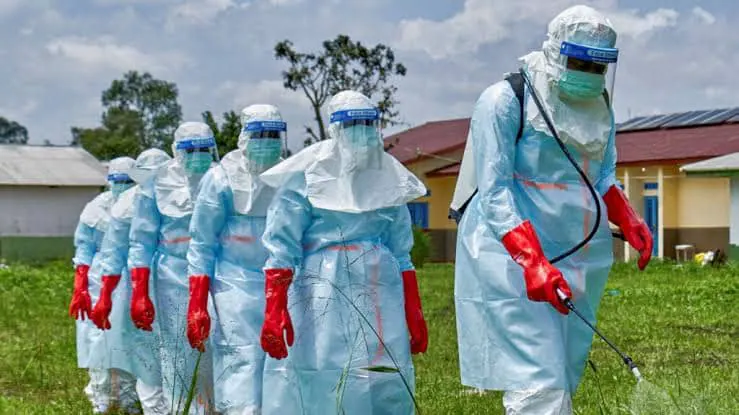
The Ebola outbreak in the Democratic Republic of Congo continues to escalate, with over 8,000 confirmed cases reported to date. According to the National Institute of Public Health (INSP), 8,116 confirmed cases have been reported, along with 2,088 recoveries and 3,924 deaths. The outbreak has affected 63 health zones across seven provinces, including Ituri, North Kivu, South Kivu, Haut-Uele, Bas-Uele, Tshopo, and Sud-Ubangi.
The INSP report also indicates that the case fatality rate stands at 48.3%, while the contact tracing rate is at 75.9%. A total of 817 people are currently in isolation. The report highlights that some health zones in Tshopo have not reported any new cases in recent days, with Lubunga, Wanie-Rukula, and Tshopo zones reporting 73, 59, and 45 days since the last confirmed case, respectively.
The DRC government and health partners are working to strengthen surveillance and response efforts in affected areas. The World Health Organization (WHO) has allocated 20,000 doses of Ebola vaccine to support the response efforts. Health workers are on the ground, providing care to patients and tracing contacts to prevent further transmission of the disease.
The Ebola outbreak was first declared in the DRC in August 2018, and since then, over 2,000 people have been cured, while over 3,900 have died. The government and international partners continue to work together to bring the outbreak under control. The situation remains closely monitored, with ongoing efforts to prevent the spread of the disease.
In addition to the Ebola response, the DRC is also addressing other health challenges, including polio and climate change. Recently, 100 physiotherapists were sensitized to strengthen surveillance against poliomyelitis in Kinshasa. The government is also working to address the country's debt, with a focus on transparency and accountability.
The International community is providing support to the DRC in its response to the Ebola outbreak. The Belgian development agency, ENABEL, is exploring partnership opportunities with the DRC's Inspectorate General of Finance (IGF) to strengthen systemic control and anti-corruption efforts. This collaboration aims to enhance the country's financial management and accountability.
The DRC's National Commission on Human Rights (CNDH) has maintained its status as a Class A member of the Global Alliance of National Human Rights Institutions (GANHRI), following a review of its accreditation. The CNDH president, Paul Nsapu, provided clarification on the process before the National Assembly, highlighting the institution's commitment to human rights and accountability.
Key points
- Over 8,000 confirmed Ebola cases reported in the DRC.
- 63 health zones affected across seven provinces.
- The case fatality rate stands at 48.3%, with a contact tracing rate of 75.9%.