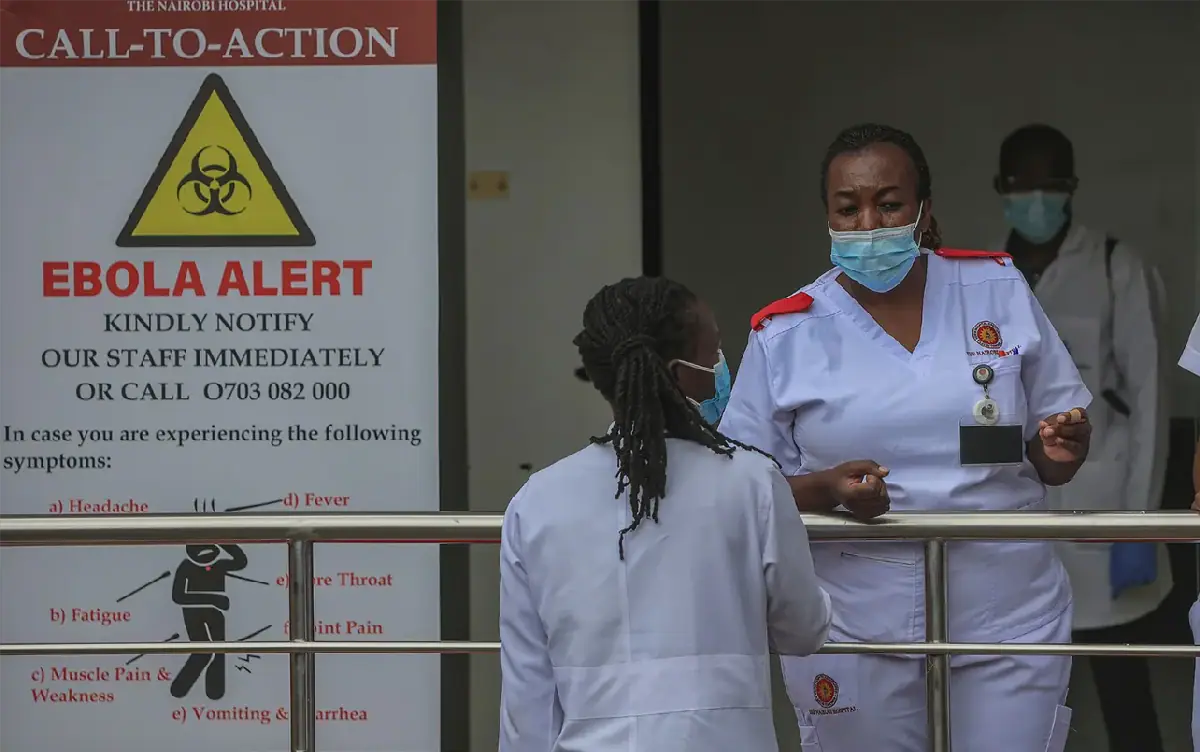
The Ebola outbreak in Africa presents a tale of two stories. On one hand, countries like Kenya, Uganda, and Nigeria have shown that early detection can be effective in containing the virus. On the other hand, the Democratic Republic of Congo, where the outbreak originated, continues to struggle with the epidemic. Kenya recently released 20 contacts of its index patient from quarantine, marking a milestone in its response to the outbreak. The country's health ministry reported that all 135 contacts had been traced, and the remaining patients are stable.
Kenya's first case was a Kenyan man who had been living in the DRC and traveled to Nairobi, where he tested positive and died on October 5. Eight more people have since fallen ill, all of them contacts who were already in quarantine, bringing Kenya to nine confirmed cases and two deaths. The country's response has been orderly, with epidemiologists finding that every patient had been exposed to the index case between October 3 and 5. Kenya's case fatality rate stands at 22.2 percent, although health officials caution that the sample size is too small to draw conclusions.
Uganda, which sits on the DRC's eastern border, recorded 20 confirmed infections and two deaths, mostly imported from the DRC. After 42 days without a locally transmitted case, Uganda declared its outbreak over on July 28. However, the country's success is now being tested by events elsewhere, as Kenya's index patient and Nigeria's first case both passed through Uganda. Kampala has barred transit for travelers with a recent DRC travel history and claims it has no confirmed active cases.
Nigeria's health minister, Muhammad Ali Pate, expressed confidence that the country can contain the outbreak, citing its experience with Ebola in 2014. The Nigeria Centre for Disease Control and Prevention (NCDC) was quickly notified, and a technical team from Africa CDC arrived in Abuja within days. Contacts now number 54, including health workers and the patient's husband. The NCDC has approved financial support for those quarantined, and six low-risk contacts are self-isolating at home.
However, Nigeria's test is only beginning, as the patient, a 42-year-old woman, developed symptoms on October 7 and was tested on October 19, a gap of about 12 days during which she sought care at a private facility. The first exposures happened among health workers who did not yet know what they were treating. The patient and her husband were evacuated to Switzerland, and the WHO counts no active confirmed case in Nigeria. Nevertheless, the NCDC director-general cautioned that the country is "not out of the woods" until every contact is followed.
The DRC, where the outbreak originated, continues to struggle with the epidemic. The ministry's latest figures put confirmed cases at 9,964 and deaths at 4,841, with a case fatality rate of 48.6 percent. Cases have been confirmed in 66 of the country's 178 health zones across eight provinces. Ituri remains the epicentre, and North Kivu carries the highest provincial fatality rate.
The DRC's outbreak is attributed to several structural problems, including the lack of a licensed vaccine or treatment for the Bundibugyo strain. The response is also complicated by the conflict zone, where parts of North Kivu are controlled by the Rwanda-backed AFC/M23. A clinical trial of candidate vaccines was announced in Bunia, but it will take time to show whether anything works.
Key points
- The Ebola outbreak in Africa highlights the importance of early detection and effective response in containing the virus.
- The Democratic Republic of Congo continues to struggle with the epidemic, while countries like Kenya, Uganda, and Nigeria have shown success in containing imported cases.
- The lack of a licensed vaccine or treatment for the Bundibugyo strain and the conflict zone in the DRC are major challenges in controlling the outbreak.