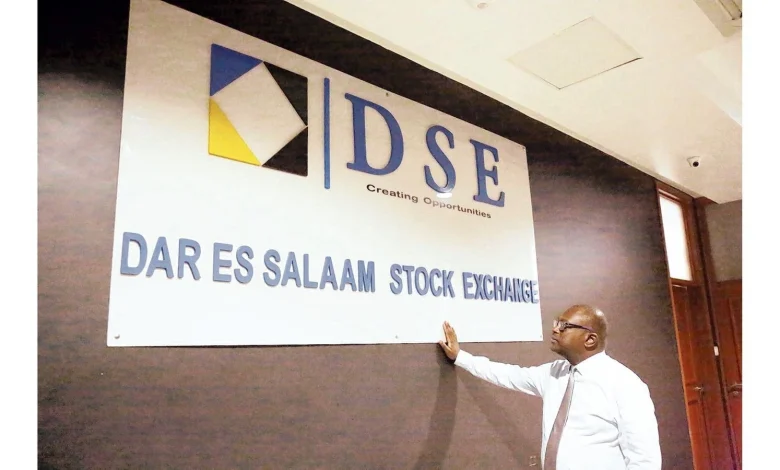
Trading activity on the Dar es Salaam Stock Exchange (DSE) declined last week, with stock values dipping and investor appetite shifting towards government bonds. According to a report by Zan Securities Limited, the slowdown in stock trading was marked by a 13 per cent decline in company share sales. Conversely, government bond auctions experienced overwhelming demand, with a five-year bond receiving nearly three times the amount of money requested.
The DSE All Share Index (DSEI), Tanzania Share Index (TSI), Industrial and Allied, and Bank, Finance and Investment indices all recorded declines last week, indicating a broader equity market slowdown. However, the Commercial Services index bucked the trend, jumping 9.22 per cent. Individual gainers included Afriprise and Vodacom, which rose 22.31 per cent and 9.91 per cent, respectively. This mixed performance suggests that while some sectors are experiencing growth, others are struggling.
Analysts at Zan Securities Limited believe that investor focus this week will centre on whether buying interest in selected equities will persist, alongside continued strong demand for government securities and momentum in the fixed-income market. Advisory and Research Manager at Zan Securities, Mr Isaac Lubeja, noted that the equity market appeared to be taking a breather rather than undergoing a sharp reversal. He emphasized that continued buying interest would indicate whether recent gains represented sustained repricing.
Mr Lubeja also identified dividend-driven activity as a potential market theme, particularly following Mkombozi Bank’s planned dividend of 100/- per share, equivalent to 2.4bn/- in total. The bank’s dividend case is supported by balance-sheet growth, with deposits rising by 27 per cent, loans by 10 per cent, and assets by 31 per cent. This growth in deposits, loans, and assets could make Mkombozi Bank an attractive investment opportunity for dividend-seeking investors.
In the fixed-income market, demand for government securities continued to strengthen, with the reopened five-year Treasury bond attracting a subscription rate of 278.31 per cent. The offer size was reduced to 142.72bn/-, while the bond yield declined to 9.53 per cent from 9.54 per cent previously. This reduced supply and stronger demand could result in aggressive bidding at upcoming primary auctions, with unmet demand potentially spilling into the secondary market.
Alpha Capital Chief Executive Officer Mr Gerase Kamugisha noted that DSE trading activity moderated last week, with equity turnover and market indices declining while fixed-income activity strengthened. Equity turnover stood at 53.05bn/-, down 13.12 per cent from the previous week, while shares traded declined by 8.92 per cent to 24.60 million. Domestic investors remained dominant, accounting for 75.73 per cent of equity sales, compared with 24.27 per cent for foreign investors.
In the secondary bond market, turnover rebounded 28.43 per cent to 104.06bn/- despite a 33.59 per cent decline in the number of trades. Average trade size nearly doubled to 1.20bn/-, pointing to increased activity in larger institutional transactions. Zan Securities said the trend could continue supporting demand for long-dated government securities, particularly 10-, 15- and 20-year Treasury bonds, with inflation at 4.3 per cent helping sustain the attractiveness of real yields.
Key points
- Investor appetite for government bonds surged to record levels, with a five-year bond receiving nearly three times the amount of money requested.
- The DSE All Share Index (DSEI) and other market indices recorded declines last week, indicating a broader equity market slowdown.
- Dividend-driven activity could be a potential market theme, particularly following Mkombozi Bank’s planned dividend.