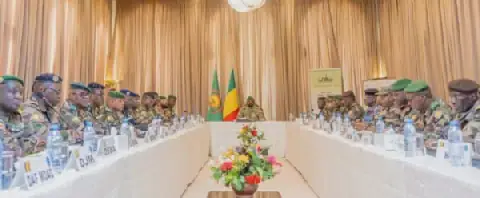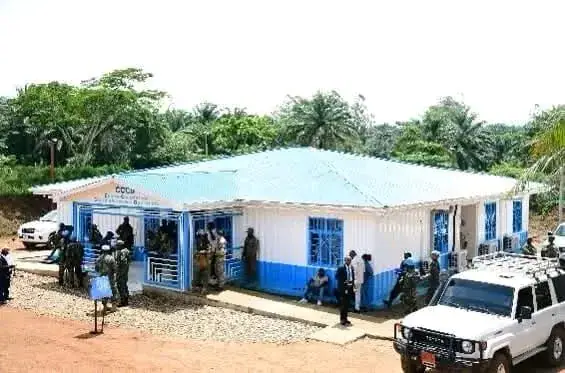
The Democratic Republic of Congo, the United Nations, and Uganda have taken a significant step in their military cooperation in the East of the country. A joint military coordination centre, known as the Centre conjoint de coordination des opérations (CCCO), was officially inaugurated on November 18, 2026, in Beni, North Kivu. This centre aims to strengthen collaboration between the Forces armées de la RDC (FARDC), the Mission de l'Organisation des Nations unies pour la stabilisation en RDC (MONUSCO), and the Forces de défense du peuple ougandais (UPDF).
The CCCO, built by MONUSCO, was inaugurated by North Kivu's military governor, Major General Somo Kakule Évariste. The centre, located in Mavivi, Beni region, will cover several areas affected by armed group activism, including Beni and Lubero territories in North Kivu, and Irumu and Mambasa territories in Ituri. The centre's primary goal is to improve military operations planning and coordination against armed groups, particularly the ADF.
The inauguration ceremony saw the North Kivu military governor praise the initiative as a symbol of cooperation between Kinshasa, Kampala, and international partners. He emphasized the need for different forces to work together to achieve results on the ground. MONUSCO Force Commander, Lieutenant General Ulisses Gomez, highlighted the importance of close coordination between military forces and called for enhanced collaboration with local communities to improve the fight against armed groups.
The opening of the CCCO comes amid a concerning security situation, marked by increased ADF attacks in North Kivu and Ituri. Despite ongoing military operations, civilians continue to bear the brunt of armed violence, particularly in Beni and Mambasa territories. The idea of establishing such a coordination mechanism was first discussed in March 2025 in Beni, during exchanges between provincial authorities and MONUSCO.
The cooperation between the Congolese and Ugandan armies is part of the "Shujaa" joint operations launched on November 30, 2021, to track down ADF fighters in the border region between the two countries. The inauguration ceremony was followed by a visit to the facilities and a first working meeting between representatives of the partner forces.
The establishment of the CCCO has raised significant expectations among North Kivu and Ituri populations, who are regularly affected by massacres, forced displacement, and insecurity. The challenge now is to translate this new coordination into concrete results, such as preventing attacks, protecting civilians, and reducing the nuisance capacity of armed groups.
The effectiveness of the CCCO will be evaluated based on the real improvement in daily security for the inhabitants of these two provinces. The centre's success will depend on its ability to enhance collaboration, coordination, and information sharing between the FARDC, MONUSCO, and UPDF.
Key points
- The joint military coordination centre aims to improve planning and coordination of military operations against armed groups in North Kivu and Ituri.
- The centre's establishment is a significant step in the military cooperation between the DRC, UN, and Uganda.
- The success of the CCCO will be evaluated based on its impact on the security situation in North Kivu and Ituri.