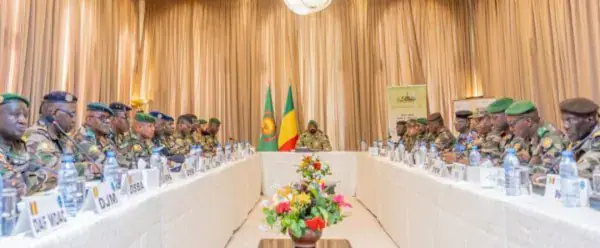
Mali's transitional president, Assimi Goïta, recently convened a meeting with the country's military chiefs of staff and defense and security service leaders in Bamako. The primary objective of this gathering was to assess the current state of the nation's forces and define future defense priorities. Discussions focused on the organization and operational capabilities of the Malian Armed Forces (FAMa) and their adaptability to existing security threats.
The meeting's agenda included an evaluation of the FAMa's structure and their capacity to respond to evolving security challenges. Following the discussions, General Oumar Diarra, the minister delegate in charge of Defense, provided insights into the presidential directives. These directives encompassed military planning, human resource management, operational conduct, and cooperation with international partners. The orientations aim to enhance the effectiveness and efficiency of Mali's defense apparatus.
A key aspect of the presidential directives was the call to sustain and intensify operations against armed groups operating within the country. President Goïta emphasized the importance of reinforcing the capabilities of the Unified Force of the Alliance of Sahel States (AES). This move is part of a broader strategy to combat terrorism and restore stability in the Sahel region. The AES was established to foster cooperation among member states in the fight against terrorism.
The situation in Mali remains complex, with various armed groups posing significant security challenges. The country has been struggling with insurgency and terrorist activities for over a decade. In response, the Malian government, with the support of international partners, has been working to strengthen its military capabilities and improve security on the ground. President Goïta's directives are seen as crucial steps toward achieving these objectives.
In line with these efforts, the Malian Armed Forces have been conducting operations against armed groups. One notable operation was the recent "Dougoukoloko" operation, which targeted several positions of armed groups. Such operations demonstrate the military's commitment to addressing the security concerns and the government's resolve to protect its territory. The operations also highlight the challenges faced by the military in maintaining security across the country.
The international community has been closely monitoring developments in Mali and the broader Sahel region. The security situation in the region has implications for global stability, and international partners have been offering support to help Mali and its neighbors address these challenges. The cooperation between Mali and its international partners is expected to play a significant role in the country's efforts to overcome its security and stability challenges.
As Mali continues to navigate its security challenges, the effectiveness of President Goïta's directives and the military's strategies will be closely watched. The success of these efforts will depend on various factors, including the level of international support, the coherence of military strategies, and the ability to address the root causes of insecurity. For now, the focus remains on implementing the president's directives and enhancing the country's defense capabilities.
Key points
- President Assimi Goïta of Mali has called on his military leaders to maintain pressure on armed groups.