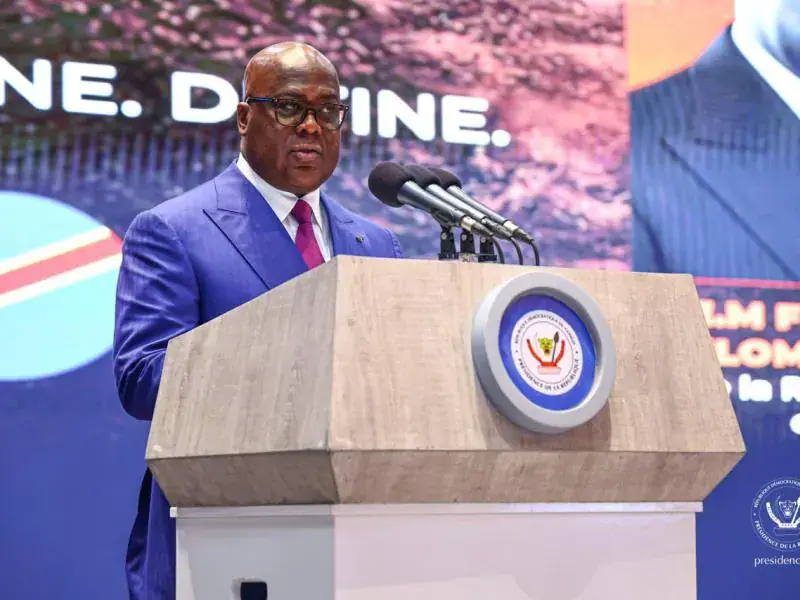
On November 23, 2026, President Félix Tshisekedi of the Democratic Republic of the Congo (DRC) addressed the 12th edition of the Makutano Forum, emphasizing the importance of local mineral transformation to enhance the country's mining sovereignty. The forum, themed "Mining Sovereignty in Action," brought together foreign delegations, public officials, mining leaders, investors, and financial institutions to discuss industrialization and increasing local value added. Tshisekedi stressed that the DRC's rich natural resources, including cobalt, copper, and lithium, are crucial for the global economy, particularly in the transition to renewable energy and digital infrastructure.
The DRC, under Tshisekedi's leadership, aims to strengthen its industrial sector to transform minerals locally and maximize benefits from its natural resources. The president noted that despite being a major producer of critical minerals, the country's economic benefits have been limited. He cited the need for the DRC to move beyond mere extraction and export of raw materials, instead focusing on creating a national industrial base, generating employment, and improving living standards. Tshisekedi emphasized that the country's potential in strategic minerals like lithium, cobalt, and copper must be harnessed to drive sustainable economic growth.
Tshisekedi highlighted the disparity between the DRC's significant mineral production and the limited economic returns for its population. He stated that the country's reliance on exporting raw materials while importing finished products has hindered its economic development. The president emphasized that true sovereignty in the mining sector involves not only owning natural resources but also controlling the value chain and reaping substantial economic benefits. He called for the DRC to develop its capacity to transform minerals locally, create jobs, and reinvest in the economy.
The president outlined the role of the state in achieving mining sovereignty, including setting clear rules, negotiating balanced partnerships, and developing national transformation capacities. Tshisekedi stressed that this endeavor does not exclude private investment or international partnerships, which are essential for the country's industrialization. He emphasized that sustainable industrialization requires capital, technology, skills, and market access. The DRC, according to Tshisekedi, must become an economy that effectively controls the transformation and valuation of its mineral resources.
Tshisekedi's vision for mining sovereignty involves the DRC taking a significant place in the global value chain, from extraction to industrialization. He noted that possessing natural resources does not automatically translate to economic mastery. The president emphasized that the true challenge lies in creating wealth from these resources, retaining a substantial share of the value created, and reinvesting it in the country's development. This approach, according to Tshisekedi, will ensure that the DRC's rich natural resources translate into sustainable economic growth and improved living standards.
The Makutano Forum, now in its 12th edition, has become a critical platform for discussing the DRC's mining sector and its role in the global economy. The event has attracted high-level participation, including representatives from Burundi, Zambia, and Chad, as well as public officials, mining leaders, investors, and financial institutions. The discussions focus on industrialization, local value addition, and increasing economic benefits for the DRC and other resource-rich countries.
The DRC's commitment to mining sovereignty and local mineral transformation is seen as a strategic move to assert its position in the global economy. By emphasizing the importance of controlling the value chain and reaping economic benefits, Tshisekedi's vision aims to drive sustainable economic growth, create jobs, and improve living standards for the Congolese people. The success of this approach will depend on effective implementation, investment, and partnerships that prioritize the country's economic development and industrialization.
Key points
- The DRC aims to strengthen its industrial sector to transform minerals locally and maximize benefits from its natural resources.
- President Tshisekedi emphasizes that true sovereignty in the mining sector involves controlling the value chain and reaping substantial economic benefits.
- The DRC's commitment to mining sovereignty and local mineral transformation is seen as a strategic move to assert its position in the global economy.