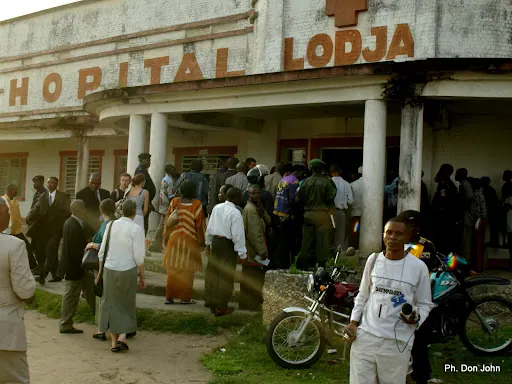
The city of Lusambo, located in the Democratic Republic of the Congo, is struggling to assume its role as the capital of Sankuru province. Despite being officially designated as the provincial capital in 2015, Lusambo's infrastructure is in a state of disrepair. Many of its public buildings were inherited from the colonial era and are no longer suitable for current administrative needs.
Several government agencies and financial institutions, including the DGI, DGRAD, DGDA, and the Central Bank of Congo, are expected to be relocated from Lodja to Lusambo, as per instructions from the Prime Minister. However, the city's current state of infrastructure raises concerns about its readiness to accommodate these institutions. The city's buildings are in a state of disrepair, with many showing signs of cracks and rusty roofs.
The city's landscape is dominated by old colonial buildings that are no longer maintained. The provincial assembly and divisions of Education and New Citizenship are currently operating in borrowed premises from the Frères de la Charité community. The financial institutions and government services do not have modern or secure buildings, with no major rehabilitation work undertaken since independence.
The social and logistical situation in Lusambo remains precarious. The city's roads are heavily degraded, and the REGIDESO network only covers a small part of the city, resulting in a shortage of electricity and water. The city's airport is little more than a dirt track, located seven kilometers from the city center, which becomes impassable during the rainy season and lacks navigation equipment.
The city's infrastructure has been neglected for decades, and there is a pressing need for modernization. The city's water and electricity supply, as well as its transportation systems, require urgent attention. The local authorities face significant challenges in providing basic services to the population.
Some efforts are being made to improve the city's infrastructure. SAFRIMEX has signed a contract to provide Lusambo with its first asphalted roads. The Japanese government has also provided funding for a bridge over the Lotembo River in Katako-Kombe. These developments are expected to improve the city's connectivity and accessibility.
Despite these efforts, much work remains to be done to bring Lusambo up to standard as a provincial capital. The city's infrastructure requires significant investment to support the relocated government agencies and financial institutions. The successful implementation of these projects will depend on continued support from the government and international partners.
Key points
- The city's infrastructure is in a state of disrepair, with many buildings showing signs of cracks and rusty roofs.
- The city's water and electricity supply, as well as its transportation systems, require urgent attention.
- Efforts are being made to improve the city's infrastructure, including the construction of asphalted roads and a bridge over the Lotembo River.