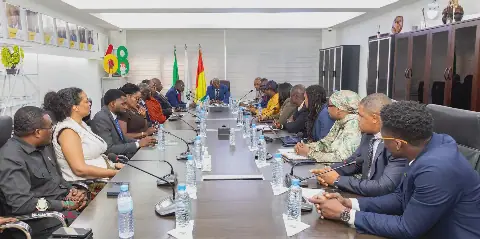
The Front pour la refondation de la nation (FRN), a politico-military movement in the Democratic Republic of the Congo, has expressed concerns that any changes to the country's constitution could lead to the collapse of the Doha peace process. The movement, led by Joseph Kabila, met with a delegation of the United Nations led by James Swan, the special representative of the UN Secretary-General and head of the MONUSCO mission. Bertrand Bisimwa, vice-president of the movement, emphasized that the agreements signed in Doha are based on the current constitution.
The FRN's concerns come as the Congolese parliament has recently adopted a proposal for a law on the organization of a referendum in the country, sparking fears among the opposition that it could pave the way for a constitutional revision allowing President Félix Tshisekedi to extend his stay in power. The movement is calling on the UN to pressure President Tshisekedi to renounce any initiative to change the constitution. Bisimwa warned that if the constitution is changed, the entire Doha peace process will collapse.
The FRN's statement has added a new dimension to the controversy surrounding the constitution. The question of constitutional change has now gone beyond the domestic debate and is being discussed in the context of the peace process in the East of the country. The movement's legitimacy has been contested internationally, but it received a high-level UN delegation for the first time on October 12, 2026.
The UN delegation was led by James Swan, who met with Bertrand Bisimwa to discuss the FRN's concerns. Bisimwa emphasized that the agreements signed in Doha, including the declaration of principles and the framework agreement, are all based on the current constitution. He warned that any changes to the constitution would compromise the implementation of these agreements.
The FRN's concerns have raised questions about the potential impact of a constitutional change on the Doha peace process. The process is aimed at resolving the security crisis in the East of the country, and any changes to the constitution could potentially undermine the progress made so far. The international community is closely watching the developments in the DR Congo, and the FRN's statement has added to the complexity of the situation.
The DR Congo has been experiencing a sensitive political climate, with the opposition expressing fears that a constitutional revision could allow President Tshisekedi to extend his stay in power. The FRN's statement has highlighted the need for the international community to be cautious in its approach to the country's constitutional issues. The UN has a delicate equation to solve: preserving the peace commitments without interfering in the DR Congo's sovereign constitutional choices.
The FRN's warning has also raised questions about the potential consequences of a constitutional change on the country's stability. The movement's legitimacy may be contested, but its statement has highlighted the need for a careful approach to the country's constitutional issues. The international community will be watching closely to see how the situation unfolds.
Key points
- The FRN warns that changing the DR Congo's constitution could collapse the Doha peace process.
- The movement is calling on the UN to pressure President Tshisekedi to renounce any initiative to change the constitution.
- The FRN's concerns have raised questions about the potential impact of a constitutional change on the country's stability and the Doha peace process.