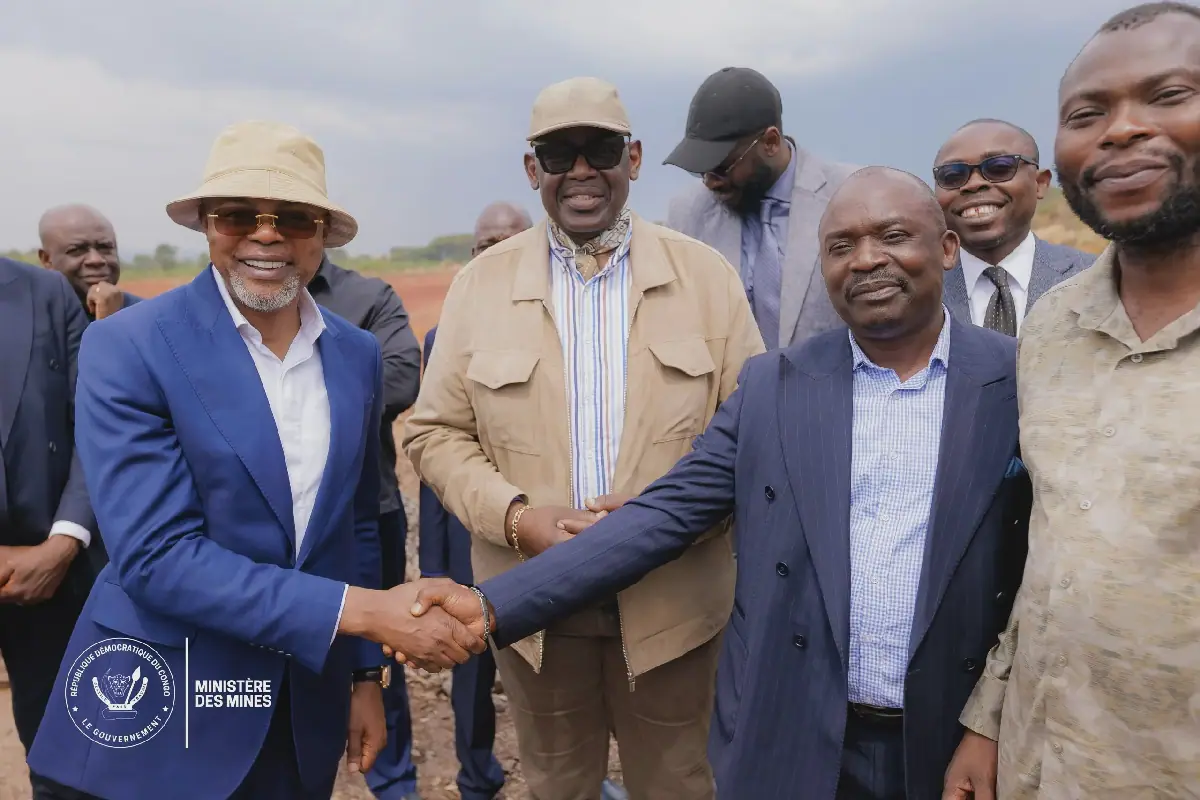
The Democratic Republic of Congo's government aims to promote coexistence between artisanal and industrial miners as a way to sanitize the mining sector. In Mulondo, Lualaba province, Mines Minister Louis Watum Kabamba oversaw the relocation of artisanal miners on November 2, 2026. They are part of the COMIKAN mining cooperative. The site, 42 kilometers southeast of Kolwezi, was previously disputed between artisanal miners and industrial operator PAJECLEM.
The dispute began when PAJECLEM, the new industrial operator, took over the site previously exploited by CHEMAF, causing artisanal miners to leave and interrupt their activities for over a year. To resolve the issue, PAJECLEM ceded two mining squares to COMIKAN. This arrangement allows artisanal miners to resume activities in a defined perimeter while the industrial operator retains its rights on the rest of the site.
Minister Louis Watum Kabamba supervised the implementation of this solution, inspecting the site and exchanging with the parties involved. He provided guidance to frame this coexistence sustainably, preventing new occupation conflicts and ensuring respect for mining regulations. The goal is to balance the interests of artisanal and industrial miners, promoting a stable mining sector.
For artisanal miners, the relocation offers a chance to restart their economic activities after a long period of inactivity. For PAJECLEM, it allows maintaining industrial operations within a negotiated framework without jeopardizing its prerogatives. This approach prioritizes dialogue and compromise in a sector often marked by tensions between artisanal and industrial mining.
The COMIKAN cooperative has welcomed the solution, with its general director expressing gratitude to President Félix-Antoine Tshisekedi Tshilombo, Prime Minister Judith Suminwa Tuluka, and Minister Louis Watum Kabamba. He urged artisanal miners to act responsibly, abandoning unethical practices and respecting site regulations. This experience aims to serve as an example for concerted management of mining areas.
The government's approach to mining regulation emphasizes that restoring state authority involves not only controls and sanctions but also mechanisms for conflict resolution and activity organization. In Mulondo, the government promotes a model based on space delimitation, recognition of actors' rights, and respect for their obligations. This initiative aligns with President Tshisekedi's vision for better governance in the mining sector.
The long-term success of this arrangement depends on the discipline of artisanal miners, respect for commitments by all parties, and government monitoring. Minister Louis Watum Kabamba aims to demonstrate a pragmatic approach, balancing industrial exploitation imperatives with the livelihoods of artisanal miners within an organized and lawful framework.
Key points
- The DR Congo government promotes coexistence between artisanal and industrial miners to sanitize the mining sector.
- A negotiated solution allows artisanal miners to resume activities in Mulondo, Lualaba province.
- The government's approach prioritizes dialogue, compromise, and responsible mining practices.