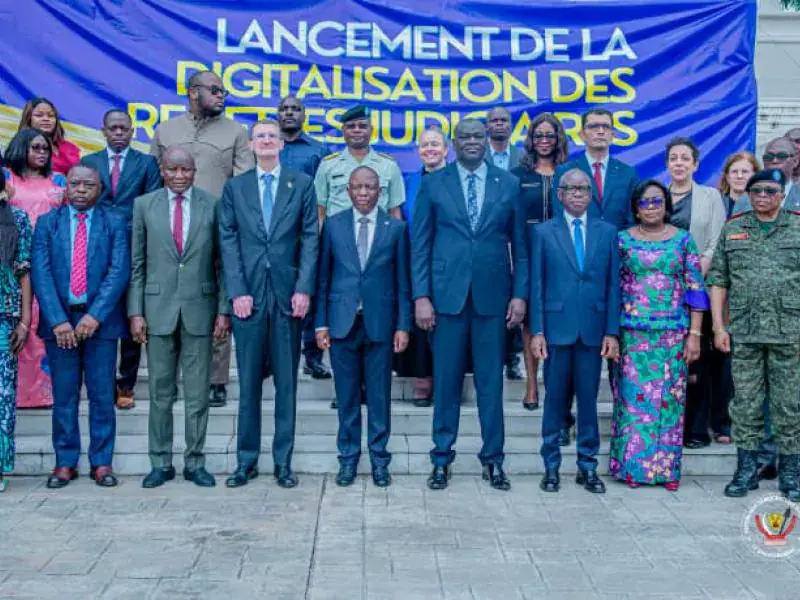
The Democratic Republic of the Congo's Ministry of Justice and Keeper of the Seals has initiated a digitalization project for judicial revenues and interconnection of courts, prosecutor's offices, and prisons. This project was officially launched on November 5, 2026, at the Palais de la Justice in Kinshasa. The initiative aims to modernize the judicial sector, enhance transparency, and improve services to citizens. The project is supported by the European Union (EU) and the United Nations Development Programme (UNDP).
The digitalization project is part of the government's efforts to modernize the state and consolidate good governance, as outlined in the President's program. It is also one of the key initiatives in the government's 2024-2028 action program, adopted by the National Assembly. The project involves the development of a secure, traceable, and verifiable digital payment system for judicial fees, aiming to replace manual mechanisms. This initiative is expected to improve the management of cases, circulation of information, and security of public revenues.
The EU Ambassador to the DR Congo, Douglas Darius Carpenter, emphasized that the digitalization of justice is not only a technical project but also a means to strengthen the rule of law, improve the daily functioning of courts and prisons, and enhance transparency. The EU is supporting two major developments: the digitalization of the judicial and penitentiary system, and the digitalization of the perception of justice ministry revenues. These reforms aim to address concrete needs, such as better case management, improved information circulation, and enhanced security of public revenues.
The UNDP Resident Representative in the DR Congo, Kamil Kayode Kamaluddeen, highlighted that digital transformation is a key driver of modernization in the public sector. In the justice sector, it should contribute to improved information circulation, secure judicial data, enhanced availability of statistics, and better quality of services rendered to citizens. The initiative involves two major transformations: the interconnection of judicial and penitentiary institutions, and the digitalization of judicial fee perception.
The interconnection of courts, prosecutor's offices, and prisons aims to establish a common, secure digital infrastructure to enhance coordination, continuity of services, and data availability. The digitalization of judicial fee perception seeks to improve transparency and traceability of payments, secure public revenues, and reduce irregularities. The project will be accompanied by training for users, maintenance mechanisms, and capacity-building for the justice ministry's IT services and beneficiary institutions.
The project's success depends on its appropriation by magistrates, judicial administration and penitentiary agents, and other users. The launch ceremony was attended by high-ranking officials, including the Minister of State for Justice, Guillaume Ngefa Atondoko Andali, the Minister of Digital Economy, Augustin Kibassa Maliba, and the EU Ambassador. The EU and UNDP have reaffirmed their commitment to supporting the DR Congo's justice sector reform.
The digitalization project is expected to have a positive impact on citizens' experience in their interactions with justice services. The EU and UNDP will continue to support the DR Congo's efforts to modernize its justice sector, with a second phase of the program planned for early 2027. The project's implementation will be monitored and evaluated to ensure its effectiveness and sustainability.
Key points
- The DR Congo's justice ministry has launched a digitalization project with EU and UNDP support to modernize the judicial sector and enhance transparency.