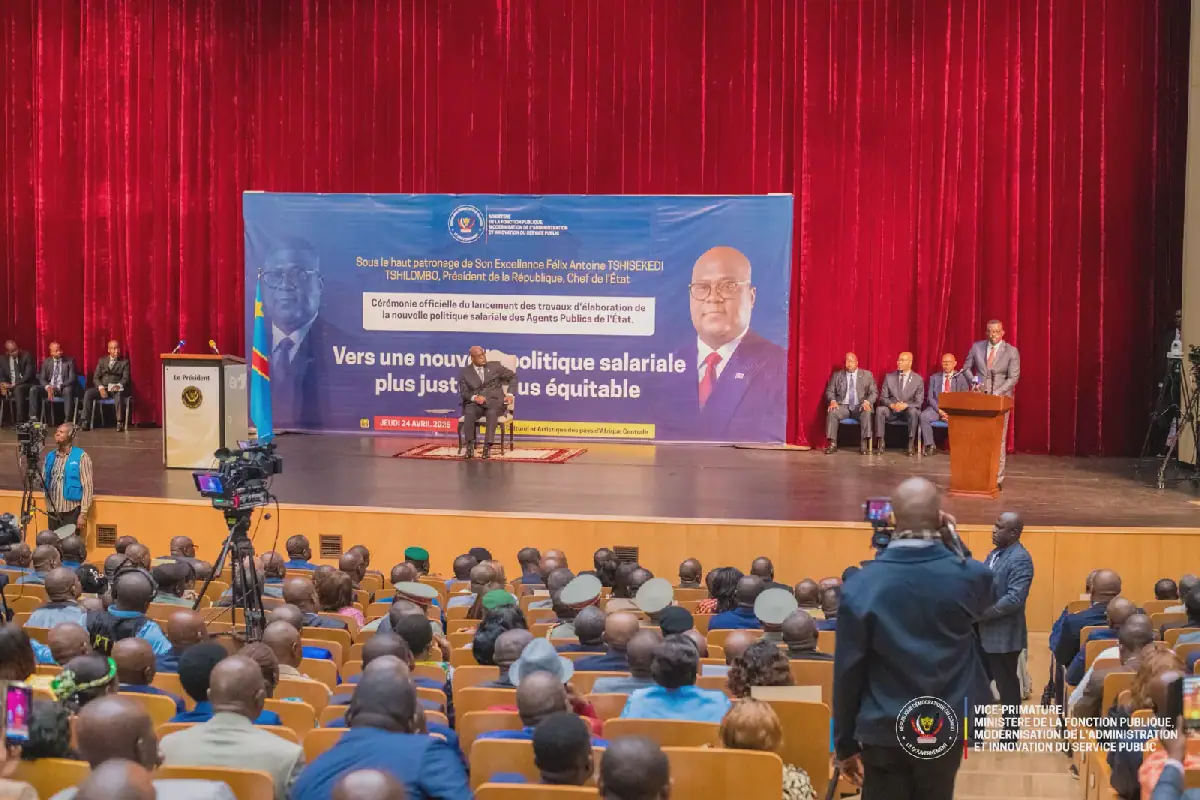
The Democratic Republic of Congo's government and union representatives gathered in Kinshasa on November 6 to launch a bipartite commission to review the salary policy of public servants. The commission, led by Vice-Premier Minister and Minister of Public Service Jean-Pierre Lihau Ebua, aims to address concerns over public servants' remuneration and working conditions. The two-day meeting brings together government officials and union representatives to discuss several demands related to improving public servants' salaries.
The commission's primary objective is to find consensual solutions to public servants' concerns while considering recommendations from multilateral partners, including the International Monetary Fund (IMF) and the World Bank. In his opening address, Lihau emphasized the importance of social dialogue in maintaining peace within the public administration. He stated that the commission provides a suitable framework for examining workers' demands and reducing salary disparities within the public service.
Lihau noted that the country has long operated without a clearly established salary policy, leading to inequitable remuneration for many public servants. He expressed hope that the commission's work would bring about a new era of fair compensation for public servants. The union representatives, led by Bienvenu Mulenda, first vice-president of the National Intersyndicale of Public Administration, are advocating for improved purchasing power and greater salary equity for public servants.
Mulenda stated that the discussions should focus on correcting existing disparities in treatment among public servants. The union representatives aim to establish guiding principles to rebalance public servants' remuneration conditions and promote greater social equity. The commission's discussions will center on several key issues, including salary scales, allowances, and benefits.
The participants have two days to examine the concerns raised and formulate recommendations to strengthen dialogue between the government and union organizations. Observers expect the commission's conclusions to contribute to improved social climate within the public service and enhanced administrative efficiency. The meeting is set to conclude on Saturday with the adoption of final recommendations and possibly the signing of commitments between stakeholders.
According to Radio Okapi, the current remuneration system for public servants in DR Congo is characterized by significant disparities, with basic salaries ranging from 1 to 1.29% and allowances varying from 87 to over 1,000%. Dirk Shaka, a commentator, noted that these disparities can be attributed to the complex and often opaque remuneration system.
The launch of the bipartite commission marks a significant step towards addressing public servants' concerns and promoting greater equity within the public service. The commission's recommendations are expected to have a positive impact on the livelihoods of public servants and the overall efficiency of the administration. Key stakeholders, including the government and union representatives, have expressed their commitment to working together to find mutually beneficial solutions.
Key points
- DR Congo govt, union reps meet to discuss public servants' salary policy
- Commission aims to address concerns over public servants' remuneration and working conditions
- Recommendations expected to improve social climate within public service and administrative efficiency