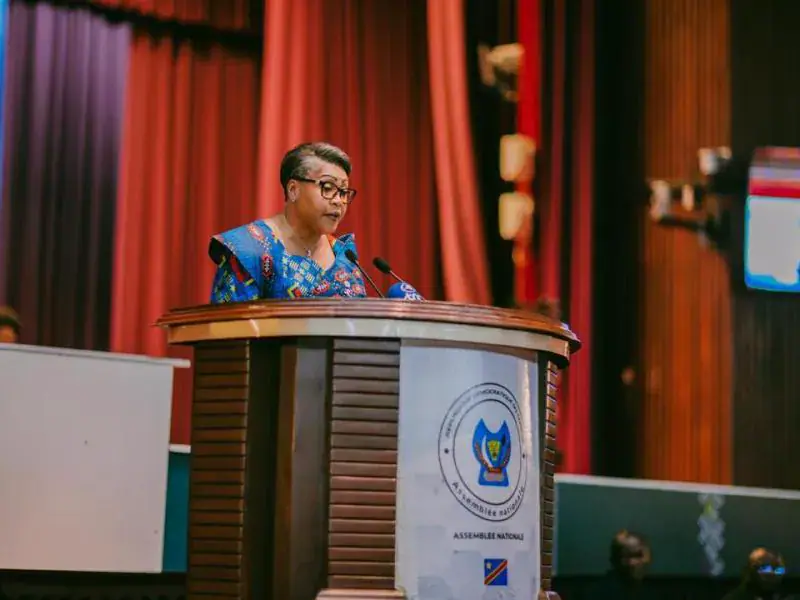
The Democratic Republic of Congo's government has presented its 2027 budget plan, focusing on strengthening public revenue mobilization, expanding the tax base, and modernizing financial administrations. Prime Minister Judith Suminwa Tuluka announced that the government aims to consolidate internal resources and reduce vulnerabilities in public finances. The budget plan, which has been declared receivable after two days of debate, outlines a medium-term framework for 2027-2029.
The government projects an average tax pressure of 13% of GDP for 2027-2029, up from 12.5% in 2026. The goal is to double current revenues to over $17.5 billion by 2027, equivalent to 40,211 billion Congolese francs. Revenues are expected to grow to 46,029 billion francs in 2028 and 52,250 billion francs in 2029. Prime Minister Tuluka emphasized that this growth will be driven by expanding the tax base, improving taxpayer identification, and combating fraud.
To achieve these goals, the government plans to modernize financial administrations, intensify tax campaigns, and implement measures such as universal standardized invoicing for VAT collection. The government also aims to strengthen fiscal and customs controls, including acquiring scanners and spectrometers, and installing weighbridges at border customs posts. Additionally, the government plans to update the income tax and corporate tax scales.
The 2027 budget plan also includes measures to exclude certain sectors from state subsidies on petroleum products. The mining, brewing, forestry, and telecommunications sectors will be gradually phased out of the subsidy program. The government also plans to subject petroleum products used in mining activities to excise duties. These measures aim to strengthen revenue mobilization and ensure that each taxpayer meets their obligations.
Prime Minister Tuluka noted that the projected revenue growth is exposed to risks, including macroeconomic shocks, commodity price volatility, and governance issues in public enterprises. The government has prepared a statement on budget risks, which outlines possible consequences and measures to mitigate them. The government aims to protect the credibility of its budget by being cautious with its assumptions.
The DR Congo government has been subsidizing petroleum products to maintain affordable prices for consumers. However, the International Monetary Fund (IMF) has urged the government to reform this subsidy system, citing its high cost and recommending targeted assistance to vulnerable households. The government's plan to phase out subsidies for certain sectors is part of a broader effort to reform the subsidy system.
The 2027 budget plan reflects the government's efforts to strengthen public finances and improve revenue mobilization. The plan's success will depend on the government's ability to implement its measures and mitigate potential risks. The government's goal is to achieve a tax pressure of 17% of GDP by 2035, which would bring the country in line with the average for sub-Saharan Africa.
Key points
- DR Congo plans to gradually exclude mining, brewing, forestry, and telecoms sectors from state subsidies on petroleum products in its 2027 budget.