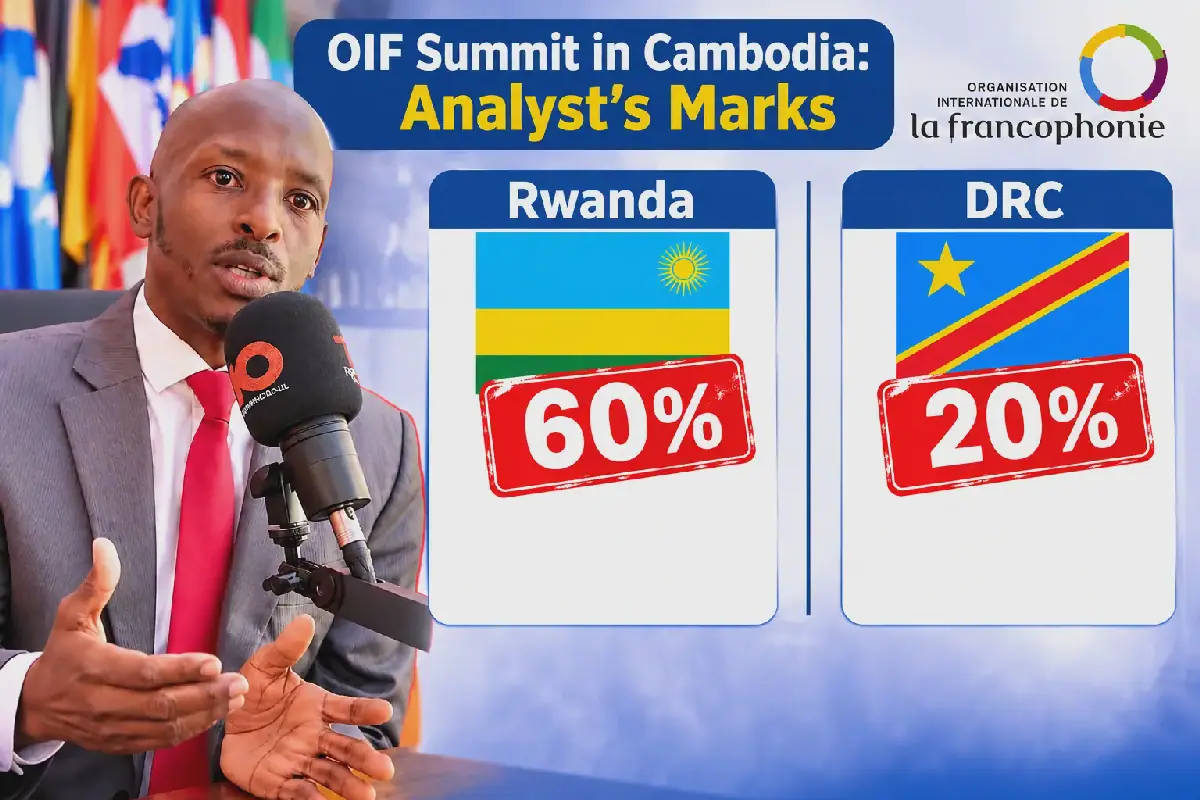
Dr. Christopher Kayumba, a political analyst and former University of Rwanda lecturer, has weighed in on the recent OIF leadership election. He believes Rwanda's diplomacy played a crucial role in securing a 60% score, while the Democratic Republic of Congo scored 20%. Kayumba's analysis comes after the OIF member states' leaders agreed to extend the term of Rwandan Louise Mushikiwabo as the organization's secretary-general for 12 months. This move was met with opposition from the DRC.
According to Kayumba, Rwanda's diplomacy demonstrated its ability to navigate complex international relationships. He praised Rwanda for not being dictated to by former colonial powers, including France and Senegal. Instead, Rwanda maintained its independence and pursued its interests. Kayumba awarded Rwanda 25% for rejecting French directives, 25% for its consistent diplomacy, and 10% for accepting the OIF leaders' decision to extend Mushikiwabo's term.
In contrast, Kayumba criticized the DRC's strategy, citing its inability to secure the top position. He noted that the DRC had initially presented a candidate but later withdrew, failing to demonstrate its capabilities. Kayumba also pointed out that the DRC's decision to withdraw its candidate was influenced by French President Emmanuel Macron. This move was seen as a sign of the DRC's lack of strategic coherence.
Kayumba further analyzed the DRC's performance, awarding it 50% for its candidate's failure to participate in the election and 20% for its inconsistent strategy. He also noted that the DRC's threat to leave the OIF if its candidate was not elected was seen as a low-level diplomatic move. The DRC's overall score of 20% reflected its inability to effectively navigate the election process.
The OIF leadership election highlighted the complex relationships between member states. Kayumba's analysis demonstrated that Rwanda's diplomacy played a significant role in securing its interests. In contrast, the DRC's strategy was seen as flawed, leading to its low score. The election outcome has implications for the future of the OIF and its member states.
Kayumba's comments provide valuable insights into the OIF leadership election. His analysis highlights the importance of effective diplomacy in achieving international goals. As a political analyst, Kayumba's comments are likely to spark further debate and discussion about the OIF and its member states.
The OIF leadership election has significant implications for the organization's future. With Louise Mushikiwabo's term extended, the organization is likely to continue on its current trajectory. However, the DRC's disappointment and criticism of the election process may lead to changes in its relationship with the OIF.
Key points
- Dr. Christopher Kayumba praises Rwanda's diplomacy, awarding it 60% for its role in the OIF leadership election.