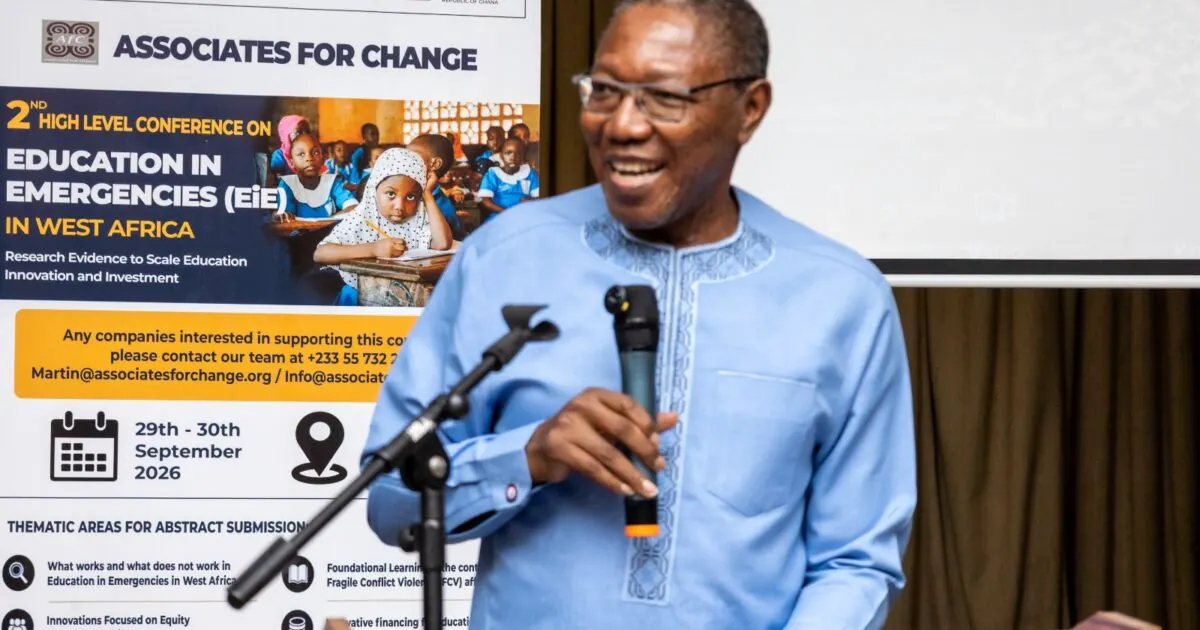
The Ministry of Education in Ghana has urged West African countries, policymakers, and development partners to invest in evidence-based education initiatives to ensure children affected by conflict, disasters, and displacement do not lose access to learning. Dr Clement Apaak, Deputy Minister for Education, made the call on behalf of the Education Minister, Haruna Iddrisu, at the Second High-Level Conference on Scaling Education Initiatives in Emergencies (EiE) West Africa in Accra.
Dr Apaak emphasized that education responses to emergencies have often been driven by urgency, which can lead to the waste of scarce resources and ineffective interventions. He noted that West Africa is facing multiple emergencies, including insecurity in the Sahel, climate-related disasters, displacement, public health crises, and economic pressures, all of which disrupt education. These crises disproportionately affect girls, children with disabilities, rural communities, and vulnerable households.
The Deputy Minister stressed that restoring access to school alone is insufficient and that foundational learning, particularly literacy and numeracy, must remain at the center of emergency education responses. He cited Ghana's experience during the COVID-19 pandemic, which demonstrated the importance of building resilient education systems capable of maintaining learning during crises. Ghana used radio, television, and online platforms to continue learning when schools were closed.
Dr Apaak identified four key investment priorities for West Africa: investing in resilience before crises occur, scaling up proven interventions, prioritizing equity in emergency education programs, and strengthening domestic financing and regional cooperation. He urged stakeholders to rely on research and data to determine which interventions work, for whom, at what cost, and under what conditions.
The ACCELERATE+ conference, held in Accra from September 29 to 30, brings together policymakers, researchers, education practitioners, innovators, development partners, and financing institutions to examine evidence and strategies for scaling education interventions in crisis-affected communities across West Africa. Dr Apaak said the ultimate measure of success should be the learning gains achieved by children, particularly those pushed furthest from classrooms by emergencies.
Dr Apaak also highlighted the role of the Ghana Education Evidence Lab and the Foundational Learning Action Tracker in monitoring progress, identifying gaps, and supporting timely interventions. He urged researchers to make their findings clear and usable, policymakers to allow evidence to influence budgets, and development partners to align their support with national priorities and commit to long-term interventions.
The Deputy Minister concluded that education should not be treated as a luxury during emergencies but as a lifeline that provides children with stability, protection, and hope. The Ministry of Education is strengthening early-grade reading, promoting mother-tongue instruction, and revising the curriculum from Kindergarten to Basic Six as part of efforts to improve foundational learning.
Key points
- Dr Apaak calls for evidence-based investments in education to support children affected by emergencies.
- Education responses to emergencies should prioritize foundational learning, particularly literacy and numeracy.
- West Africa faces multiple emergencies disrupting education, including insecurity, climate-related disasters, and public health crises.