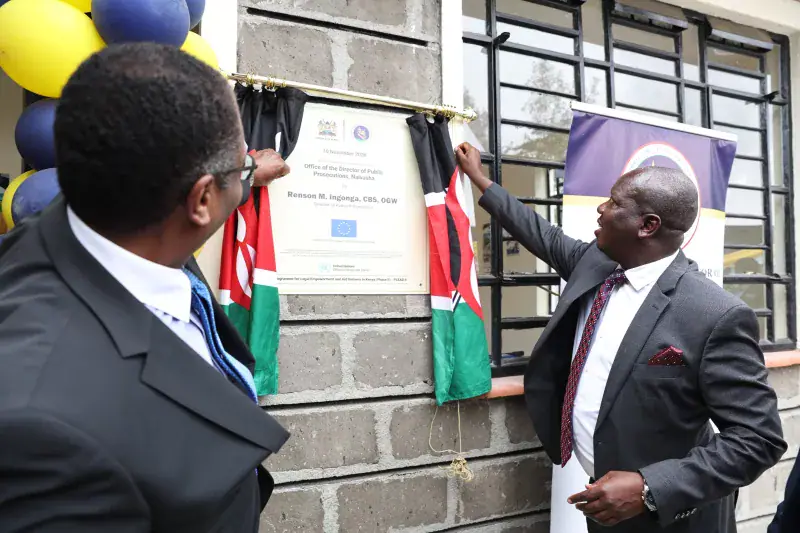
Director of Public Prosecutions Renson Ingonga has urged for greater adoption of plea bargaining and diversion to help address the backlog of cases in Kenya's justice system. According to Ingonga, these mechanisms offer alternative ways of resolving criminal cases without the need for a full trial. This approach has contributed to the efficient administration of justice by providing alternative mechanisms for handling cases. The DPP made these remarks during the commissioning of a new Office of the Director of Public Prosecutions (ODPP) office in Naivasha.
The new ODPP office in Naivasha was made possible through a project supported by the European Union and implemented by the United Nations Office on Drugs and Crime (UNODC) under the Programme for Legal Empowerment and Aid Delivery (PLEAD II). Ingonga noted that the office is timely, given the extensive geographical area it serves, including Naivasha town, Gilgil, Mai Mahiu, Longonot, and the Nairobi-Nakuru Highway corridor. Prosecutors in this area handle a wide range of cases, including murder, gender-based violence, land fraud, environmental crimes, children's matters, and arson.
Ingonga emphasized that adequate working facilities are necessary for prosecutors to manage cases effectively, hold pre-trial conferences with witnesses, and conduct prosecution-guided investigations. He also highlighted the need for joint case reviews between prosecutors and investigating officers to strengthen the handling of criminal cases. The DPP expressed his gratitude to UNODC for investing in the office, assuring that it would serve its purpose in terms of cases received and handled, as well as the timely decision to charge.
Ingonga acknowledged the European Union's support through the UNODC programme, saying the partnership had made the construction of the facility possible. He further emphasized the need for cooperation among institutions involved in the administration of justice, noting that no single agency could deliver justice independently. Ingonga stressed that justice requires strong, deliberate, and sustained cooperation among all actors in the criminal justice chain.
UNODC Regional Representative Ali El-Bereir commended Ingonga for supporting the establishment of the office through the partnership. El-Bereir noted that the collaboration had supported the establishment of prosecution offices as well as the development and implementation of policies and guidelines aimed at improving access to justice. This partnership has contributed to the improvement of justice administration in Kenya.
Naivasha Presiding Judge Lady Justice Cecilia Githua described the commissioning of the office as a significant achievement, saying the facility would make it easier for members of the public to access prosecution services. She noted that the new office would improve the efficiency and accessibility of prosecution services in the area, which would ultimately contribute to the administration of justice.
The establishment of the new ODPP office in Naivasha is a significant step towards improving access to justice in the region. Key to this effort is the increased use of plea bargaining and diversion, as advocated by DPP Ingonga. Three key points have emerged from this development: firstly, the need for cooperation among institutions involved in justice administration; secondly, the importance of adequate working facilities for prosecutors; and thirdly, the role of partnerships in supporting the establishment of prosecution offices and improving access to justice.
Key points
- Increased use of plea bargaining and diversion can help address case backlogs in Kenya's justice system.
- Adequate working facilities are necessary for prosecutors to manage cases effectively.
- Partnerships have contributed to the improvement of justice administration in Kenya.