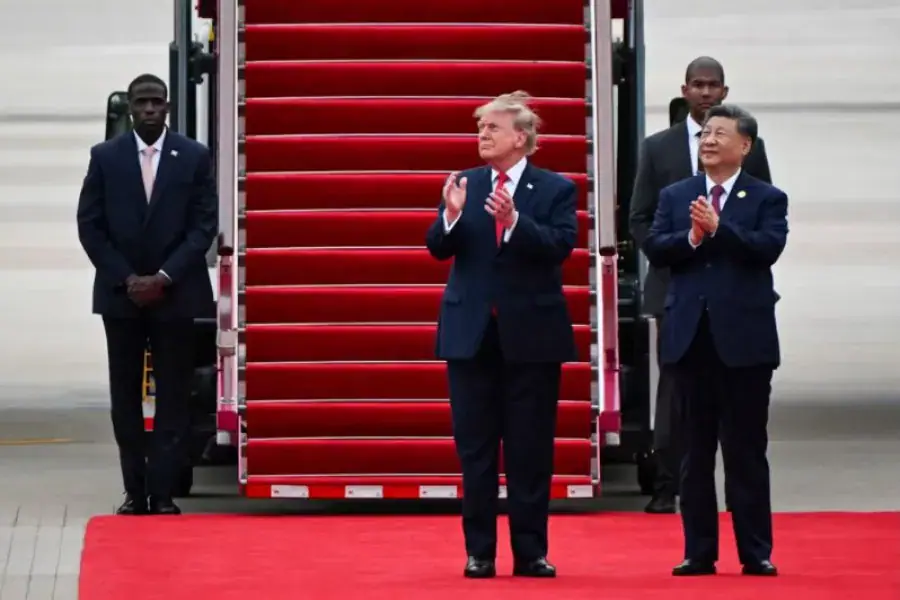
US President Donald Trump arrived in Shenzhen, China, on Wednesday, November 18, 2026, for a highly anticipated tripartite summit with Chinese President Xi Jinping and Russian President Vladimir Putin. The meeting, taking place on Thursday, has generated significant attention globally, particularly among nations worried about potential deals that might be made at their expense. Trump's visit comes after a two-hour flight from the Philippines, where he participated in an Association of Southeast Asian Nations (ASEAN) summit.
Xi Jinping, who rarely greets foreign leaders at the airport, personally welcomed Trump upon his arrival, reciprocating a similar gesture made by Trump in September at the White House. The two leaders are set to discuss various issues, including cooperation in energy, artificial intelligence, and finance. Meanwhile, Putin, who arrived in Shenzhen on Tuesday night, met with Xi Jinping for over two hours on Wednesday, including a luncheon, to discuss bilateral relations and international affairs.
The tripartite summit has drawn comparisons to the 1945 Yalta Conference, where the United States, the United Kingdom, and the Soviet Union shaped post-World War II global politics. However, experts warn that the meeting may not yield significant outcomes. Putin has expressed expectations of a "very useful" meeting, marking his return to a diplomatic gathering with Western leaders in nearly five years. The Russian leader has also emphasized that sanctions imposed by the West have failed to "destroy" his country's economy.
The agenda for the tripartite summit remains unclear, with China only stating that discussions will focus on "world peace" and "strategic stability in relations between major powers." Trump has indicated that he intends to discuss denuclearization and the Iran war, while also mentioning the possibility of addressing the Ukraine conflict. Additionally, Trump has suggested that he might meet with North Korean leader Kim Jong Un during his visit to China, with Kim reportedly expressing interest in attending.
The summit coincides with escalating tensions in the Gulf region, where Bahrain and Kuwait have reported foiling aerial attacks following US strikes on an Iranian missile site. Ukraine has also launched a symbolic attack on the Crimean Bridge. As Trump seeks diplomatic gains to offset his recent electoral defeat, Xi Jinping aims to solidify China's position on the global stage, while Putin seeks to demonstrate Russia's continued influence as a major power.
The meeting between Xi Jinping and Putin marks their fourth in-person encounter this year and the 50th since Xi assumed the presidency in 2013. The two leaders have emphasized their commitment to fostering a new type of relationship between major powers, based on mutual respect. They have also expressed a shared goal of promoting a multipolar world order, with Putin stating that Russia and China can work together to ensure peace and prosperity in the Asia-Pacific region.
As the summit gets underway, the international community remains cautious about potential outcomes, with many nations watching closely for signs of cooperation or conflict. The possibility of a separate meeting between Putin and Trump has been raised, with Trump indicating that he would be open to such a discussion. The last meeting between the two leaders took place in August 2025 in Alaska.
Key points
- The tripartite summit between Trump, Xi Jinping, and Putin has generated significant global interest and concern about potential deals that might be made at the expense of other nations.
- The meeting has drawn comparisons to the 1945 Yalta Conference, but experts warn that it may not yield significant outcomes.
- The leaders are expected to discuss various issues, including cooperation in energy, artificial intelligence, and finance, as well as international affairs such as denuclearization and the Ukraine conflict.
Reporting sources
- Arrivé en Chine, Donald Trump reçoit... · Maliweb.net